


Page 264 - Modular design for machine tools
P. 264
Engineering Design Fundamentals and Single Flat Joint Characteristics        223

               uncertainty in quantitatively determining the magnitude of the flatness
               deviation, although the surface roughness can clearly be indicated on the
               drawing. This induces another problem—the test specimen with quan-
               tified flatness deviation cannot be produced. In consideration of such
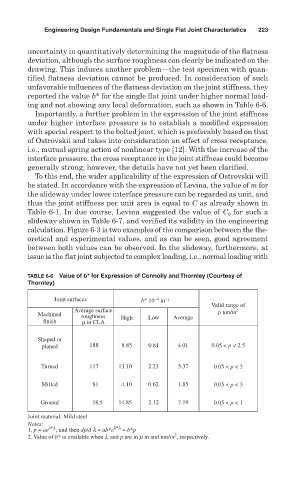
               unfavorable influences of the flatness deviation on the joint stiffness, they
               reported the value b* for the single flat joint under higher normal load-
               ing and not showing any local deformation, such as shown in Table 6-6.
                 Importantly, a further problem in the expression of the joint stiffness
               under higher interface pressure is to establish a modified expression
               with special respect to the bolted joint, which is preferably based on that
               of Ostrovskii and takes into consideration an effect of cross receptance,
               i.e., mutual spring action of nonlinear type [12]. With the increase of the
               interface pressure, the cross receptance in the joint stiffness could become
               generally strong; however, the details have not yet been clarified.
                 To this end, the wider applicability of the expression of Ostrovskii will
               be stated. In accordance with the expression of Levina, the value of m for
               the slideway under lower interface pressure can be regarded as unit, and
               thus the joint stiffness per unit area is equal to C as already shown in
                                                                       for such a
               Table 6-1. In due course, Levina suggested the value of C 0
               slideway shown in Table 6-7, and verified its validity in the engineering
               calculation. Figure 6-3 is two examples of the comparison between the the-
               oretical and experimental values, and as can be seen, good agreement
               between both values can be observed. In the slideway, furthermore, at
               issue is the flat joint subjected to complex loading, i.e., normal loading with

               TABLE 6-6 Value of b* for Expression of Connolly and Thornley (Courtesy of
               Thornley)

                       Joint surfaces         b* 10  in –1
                                                  –4
                                                                 Valid range of
                            Average surface                        p ton/in 2
                  Machined    roughness  High   Low    Average
                    finish    m in CLA
                  Shaped or
                   planed       188      8.85   0.81    4.01     0.05 < p < 2.5

                   Turned       117     13.10   2.23    5.37      0.05 < p < 3

                   Milled        81      4.10   0.62     1.85     0.05 < p < 3

                   Ground        18.5   14.85   2.12     7.19     0.05 < p < 1

               Joint material: Mild steel
               Notes:
               1. p = ae b*l , and then dp/d l = ab*e b*l  = b*p
                                                       2
               2. Value of b* is available when l and p are in m in and ton/in , respectively.

