


Page 266 - Modular design for machine tools
P. 266
Engineering Design Fundamentals and Single Flat Joint Characteristics        225

                                                                     M

                                                                      P


                                                                   150
                  0.08
                                     Interface pressure
                  0.07               p = 0.55 kgf/cm 2
                  0.06
                                                                2.15
                                              1.1 kgf/cm 2              4.15
                  0.05
                 φ,  m m/cm  0.04                                        6.8
                                                                        10.2
                  0.03                                                 13.5

                  0.02
                  0.01
                    0
                                  100          200          300          400
                                                    .
                                                M, kgf cm
                      Note: The joint has a rectangular shape, both faces are hand-scraped, both elements are
                                made of cast iron.
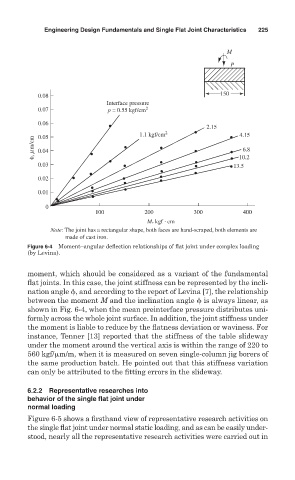
               Figure 6-4 Moment–angular deflection relationships of flat joint under complex loading
               (by Levina).


               moment, which should be considered as a variant of the fundamental
               flat joints. In this case, the joint stiffness can be represented by the incli-
               nation angle  , and according to the report of Levina [7], the relationship
               between the moment M and the inclination angle   is always linear, as
               shown in Fig. 6-4, when the mean preinterface pressure distributes uni-
               formly across the whole joint surface. In addition, the joint stiffness under
               the moment is liable to reduce by the flatness deviation or waviness. For
               instance, Tenner [13] reported that the stiffness of the table slideway
               under the moment around the vertical axis is within the range of 220 to
               560 kgf/ m/m, when it is measured on seven single-column jig borers of
               the same production batch. He pointed out that this stiffness variation
               can only be attributed to the fitting errors in the slideway.

               6.2.2  Representative researches into
               behavior of the single flat joint under
               normal loading
               Figure 6-5 shows a firsthand view of representative research activities on
               the single flat joint under normal static loading, and as can be easily under-
               stood, nearly all the representative research activities were carried out in

