


Page 271 - Modular design for machine tools
P. 271
230   Engineering Design for Machine Tool Joints

                                        Directions of
                                  machining relative to each other
                  10                       q

                   9

                   8 7
                 Mean interface pressure ton/in 2  6 5 4  Equivalent solid  30°


                                                                  0°
                                                                  90°
                   3
                                                                  60°  q
                   2
                                                             Scale-m in
                   1
                                                       0       200      400
                   0
                                  Deflection normal to joint
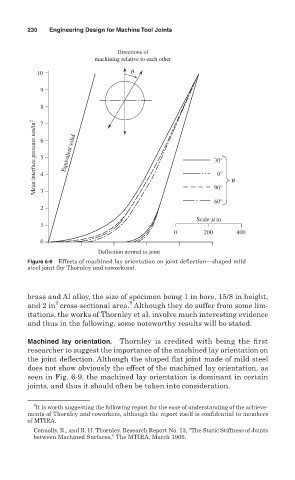
               Figure 6-9 Effects of machined lay orientation on joint deflection—shaped mild
               steel joint (by Thornley and coworkers).


               brass and Al alloy, the size of specimen being 1 in bore, 15/8 in height,
                                           8
                       2
               and 2 in cross-sectional area. Although they do suffer from some lim-
               itations, the works of Thornley et al. involve much interesting evidence
               and thus in the following, some noteworthy results will be stated.
               Machined lay orientation.  Thornley is credited with being the first
               researcher to suggest the importance of the machined lay orientation on
               the joint deflection. Although the shaped flat joint made of mild steel
               does not show obviously the effect of the machined lay orientation, as
               seen in Fig. 6-9, the machined lay orientation is dominant in certain
               joints, and thus it should often be taken into consideration.


                 8
                  It is worth suggesting the following report for the ease of understanding of the achieve-
               ments of Thornley and coworkers, although the report itself is confidential to members
               of MTIRA.
                 Connolly, R., and R. H. Thornley, Research Report No. 13, “The Static Stiffness of Joints
                 between Machined Surfaces,” The MTIRA, March 1966.

