


Page 274 - Modular design for machine tools
P. 274
Engineering Design Fundamentals and Single Flat Joint Characteristics        233


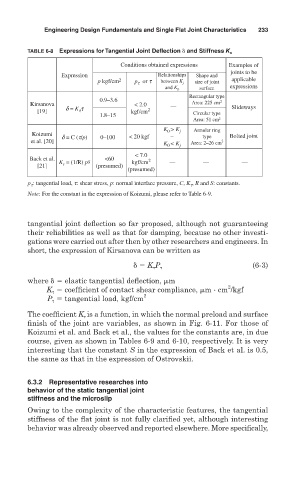
               TABLE 6-8 Expressions for Tangential Joint Deflection
 and Stiffness K s
                                        Conditions obtained expressions  Examples of
                                                                      joints to be
                         Expression                Relationships  Shape and
                                  p kgf/cm 2  p   or t  between K j  size of joint   applicable
                                             t
                                                    and K 0   surface  expressions
                                                           Rectangular type
                                   0.9–3.6
                Kirsanova                   < 2.0     —     Area: 225 cm 2  Slideways
                  [19]    d = K t          kgf/cm 2
                             t
                                   1.8–15                   Circular type
                                                            Area: 51 cm 2
                                                      > K
                                                    K 0  j  Annular ring
                 Koizumi   d = C (t/p)  0–100  < 20 kgf  –     type   Bolted joint
                et al. [20]                                         2
                                                    K < K j  Area: 2–26 cm
                                                     0
                                            < 7.0
                Back et al.         <60         2
                        K s  = (1/R) p S   kgf/cm     —        —         —
                  [21]            (presumed)
                                          (presumed)
               p : tangential load, t: shear stress, p: normal interface pressure, C, K , R and S: constants.
                t
                                                           t
               Note: For the constant in the expression of Koizumi, please refer to Table 6-9.
               tangential joint deflection so far proposed, although not guaranteeing
               their reliabilities as well as that for damping, because no other investi-
               gations were carried out after then by other researchers and engineers. In
               short, the expression of Kirsanova can be written as

  K P                          (6-3)

               where
  elastic tangential deflection,  m
                                                                     2
                     K   coefficient of contact shear compliance,  m   cm /kgf

                     P   tangential load, kgf/cm 2

               The coefficient K is a function, in which the normal preload and surface

               finish of the joint are variables, as shown in Fig. 6-11. For those of
               Koizumi et al. and Back et al., the values for the constants are, in due
               course, given as shown in Tables 6-9 and 6-10, respectively. It is very
               interesting that the constant S in the expression of Back et al. is 0.5,
               the same as that in the expression of Ostrovskii.


               6.3.2  Representative researches into
               behavior of the static tangential joint
               stiffness and the microslip
               Owing to the complexity of the characteristic features, the tangential
               stiffness of the flat joint is not fully clarified yet, although interesting
               behavior was already observed and reported elsewhere. More specifically,

