


Page 181 - Multifunctional Photocatalytic Materials for Energy
P. 181
Metal-based semiconductor nanomaterials for thin-film solar cells   167


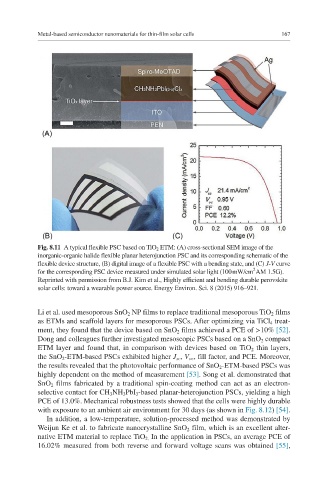
           Fig. 8.11  A typical flexible PSC based on TiO 2  ETM: (A) cross-sectional SEM image of the
           inorganic-organic halide flexible planar heterojunction PSC and its corresponding schematic of the
           flexible device structure, (B) digital image of a flexible PSC with a bending state, and (C) J-V curve
                                                                     2
           for the corresponding PSC device measured under simulated solar light (100 mW/cm  AM 1.5G).
           Reprinted with permission from B.J. Kim et al., Highly efficient and bending durable perovskite
           solar cells: toward a wearable power source. Energy Environ. Sci. 8 (2015) 916–921.


           Li et al. used mesoporous SnO 2  NP films to replace traditional mesoporous TiO 2  films
           as ETMs and scaffold layers for mesoporous PSCs. After optimizing via TiCl 4  treat-
           ment, they found that the device based on SnO 2  films achieved a PCE of >10% [52].
           Dong and colleagues further investigated mesoscopic PSCs based on a SnO 2  compact
           ETM layer and found that, in comparison with devices based on TiO 2  thin layers,
           the SnO 2 -ETM-based PSCs exhibited higher J sc , V oc , fill factor, and PCE. Moreover,
           the results revealed that the photovoltaic performance of SnO 2 -ETM-based PSCs was
           highly dependent on the method of measurement [53]. Song et al. demonstrated that
           SnO 2  films fabricated by a traditional spin-coating method can act as an electron-
           selective contact for CH 3 NH 3 PbI 3 -based planar-heterojunction PSCs, yielding a high
           PCE of 13.0%. Mechanical robustness tests showed that the cells were highly durable
           with exposure to an ambient air environment for 30 days (as shown in Fig. 8.12) [54].
              In addition, a low-temperature, solution-processed method was demonstrated by
           Weijun Ke et al. to fabricate nanocrystalline SnO 2  film, which is an excellent alter-
           native ETM material to replace TiO 2.  In the application in PSCs, an average PCE of
           16.02% measured from both reverse and forward voltage scans was obtained [55],

