


Page 126 - Book Hosokawa Nanoparticle Technology Handbook
P. 126
FUNDAMENTALS                                            CH. 2 STRUCTURAL CONTROL OF NANOPARTICLES


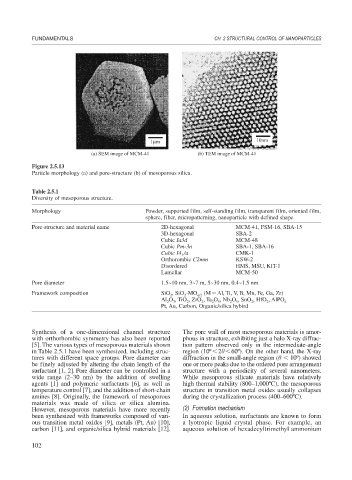
                                                       1μm                             10nm
                                    (a) SEM image of MCM-41          (b) TEM image of MCM-41
                  Figure 2.5.13
                  Particle morphology (a) and pore-structure (b) of mesoporous silica.

                  Table 2.5.1
                  Diversity of mesoporous structure.

                  Morphology                         Powder, supported film, self-standing film, transparent film, oriented film,
                                                     sphere, fiber, micropatterning, nanoparticle with defined shape
                  Pore-structure and material name        2D-hexagonal           MCM-41, FSM-16, SBA-15
                                                          3D-hexagonal           SBA-2
                                                          Cubic Ia3d             MCM-48
                                                          Cubic Pm-3n            SBA-1, SBA-16
                                                          Cubic I4 /a            CMK-1
                                                                1
                                                          Orthorombic C2mm       KSW-2
                                                          Disordered             HMS, MSU, KIT-1
                                                          Lamellar               MCM-50
                  Pore diameter                           1.5~10 nm, 3~7 m, 5~30 nm, 0.4~1.5 nm
                  Framework composition                   SiO , SiO -MO n/2  (M Al, Ti, V, B, Mn, Fe, Ga, Zr)
                                                             2
                                                                 2
                                                          Al O , TiO , ZrO , Ta O , Nb O , SnO , HfO , AlPO 4
                                                                           5
                                                                          2
                                                                                 5
                                                                               2
                                                              3
                                                            2
                                                                      2
                                                                  2
                                                                                      2
                                                                                          2
                                                          Pt, Au, Carbon, Organic/silica hybird
                  Synthesis of a one-dimensional channel structure  The pore wall of most mesoporous materials is amor-
                  with orthorhombic symmetry has also been reported  phous in structure, exhibiting just a halo X-ray diffrac-
                  [5]. The various types of mesoporous materials shown  tion pattern observed only in the intermediate-angle
                  in Table 2.5.1 have been synthesized, including struc-  region (10º 2  60º). On the other hand, the X-ray
                  tures with different space groups. Pore diameter can  diffraction in the small-angle region (    10º) showed
                  be finely adjusted by altering the chain length of the  one or more peaks due to the ordered pore arrangement
                  surfactant [1, 2]. Pore diameter can be controlled in a  structure with a periodicity of several nanometers.
                  wide range (2–30 nm) by the addition of swelling  While mesoporous silicate materials have relatively
                  agents [1] and polymeric surfactants [6], as well as  high thermal stability (800–1,000ºC), the mesoporous
                  temperature control [7], and the addition of short-chain  structure in transition metal oxides usually collapses
                  amines [8]. Originally, the framework of mesoporous  during the crystallization process (400–600ºC).
                  materials was made of silica or silica alumina.
                  However, mesoporous materials have more recently  (2) Formation mechanism
                  been synthesized with frameworks composed of vari-  In aqueous solution, surfactants are known to form
                  ous transition metal oxides [9], metals (Pt, Au) [10],  a lyotropic liquid crystal phase. For example, an
                  carbon [11], and organic/silica hybrid materials [12].  aqueous solution of hexadecyltrimethyl ammonium
                  102

