


Page 439 - Book Hosokawa Nanoparticle Technology Handbook
P. 439
7.4 REMOVAL OF NANOPARTICLES                                                 FUNDAMENTALS
                  7.4.3 Removal of nanoparticles in liquid        One of the major factors limiting the use of mem-
                                                                 brane filtration is membrane fouling, resulting in a
                  There are two types of methods that differ in the way  dramatic decline in flux with time of operation.
                  the nanoparticles in liquid are collected.  The first  To account for the membrane fouling, the resistance-
                  group, called membrane filtration, constrains the par-  in-series model is frequently employed.  The resist-
                  ticles by a membrane, and the liquid is allowed to  ance model becomes
                  flow freely through the membrane. In the second
                  group of ultracentrifugation, the liquid is constrained   dv   p          p
                  in a rotating vessel, and the particles move freely   u                              (7.4.1)
                                                                        1
                  within the liquid by an external field of acceleration    d     R  t   ( R bm     R +  R )
                                                                                              c
                                                                                                 cp
                  caused by ultracentrifugal field. These methods have
                  been quite extensively used in separation of macro-  where u is the permeate flux, v the filtrate volume
                                                                       1
                  molecules and molecules from liquid, and they are  per unit membrane area,   the filtration time, p the
                  recently becoming important also in separation of  applied transmembrane pressure,    the viscosity of
                  nanoparticles from liquid.                     the permeate, R the total resistance, R bm  the resistance
                                                                             t
                                                                 of the membrane per se plus the clogging of the mem-
                    7.4.3.1 Fouling mechanism in membrane filtration  brane pores, R the resistance of the filter cake, and
                                                                            c
                  In pressure-driven membrane filtration processes, the  R cp  the resistance of the concentration polarization
                  pressure gradient across the membrane would force  layer. Significance of each resistance in membrane
                  solvent and smaller species through the pores of   filtration is as follows.
                  the membrane, while the larger molecules/particles  The membrane, even in the absence of any sus-
                  would be retained. Membrane filtration processes are  pended particle, has a natural flow resistance. During
                  usually classified into three general categories  membrane filtration, particles become attached to the
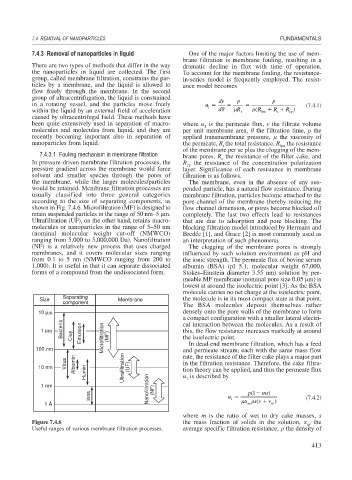
                  according to the size of separating components, as  pore channel of the membrane thereby reducing the
                  shown in Fig. 7.4.6. Microfiltration (MF) is designed to  flow channel dimension, or pores become blocked off
                  retain suspended particles in the range of 50 nm–5  m.  completely. The last two effects lead to resistances
                  Ultrafiltration (UF), on the other hand, retains macro-  that are due to adsorption and pore blocking.  The
                  molecules or nanoparticles in the range of 5–50 nm  blocking filtration model introduced by Hermans and
                  (nominal molecular weight cut-off (NMWCO)      Bredée [1], and Grace [2] is most commonly used as
                  ranging from 5,000 to 5,000,000 Da). Nanofiltration  an interpretation of such phenomena.
                  (NF) is a relatively new process that uses charged  The clogging of the membrane pores is strongly
                  membranes, and it covers molecular sizes ranging  influenced by such solution environment as pH and
                  from 0.1 to 5 nm (NMWCO ranging from 200 to    the ionic strength. The permeate flux of bovine serum
                  1,000). It is useful in that it can separate dissociated  albumin (BSA) (pI 5.1, molecular weight 67,000,
                  forms of a compound from the undissociated form.   Stokes–Einstein diameter 3.55 nm) solution by per-
                                                                 meable MF membrane (nominal pore size 0.05  m) is
                                                                 lowest at around the isoelectric point [3]. As the BSA
                                                                 molecule carries no net charge at the isoelectric point,
                           Separating
                    Size                     Membrane            the molecule is in its most compact state at that point.
                           component
                                                                 The BSA molecules deposit themselves rather
                    10 μm                                        densely onto the pore walls of the membrane to form
                                                                 a compact configuration with a smaller lateral electri-
                           Bacteria                              cal interaction between the molecules. As a result of
                     1 μm     Clay  Emulsion  Microfiltration  (MF)  this, the flow resistance increases markedly at around
                                                                 the isoelectric point.
                                                                  In dead-end membrane filtration, which has a feed
                   100 nm                                        and permeate stream, each with the same mass flow
                            Virus  Albumin                       rate, the resistance of the filter cake plays a major part
                                                                 in the filtration resistance. Therefore, the cake filtra-
                    10 nm         Humin       Ultrafiltration  (UF)  tion theory can be applied, and thus the permeate flux
                                                                 u is described by
                     1 nm                             Nanofiltration  (NF)  1
                                    Ions                                       u     p 1 (  ms)        (7.4.2)
                                                                               1
                                                                                     av
                                                                                            m
                      1 Å                                                               sv  (  v )
                                                                 where  m is the ratio of wet to dry cake masses,  s
                  Figure 7.4.6                                   the mass fraction of solids in the solution,    av  the
                  Useful ranges of various membrane filtration processes.  average specific filtration resistance,   the density of

                                                                                                        413

