


Page 520 - Book Hosokawa Nanoparticle Technology Handbook
P. 520
APPLICATIONS                            18 DEVELOPMENT OF HIGH-PERFORMANCE ELECTROCHEMICAL REACTORS

                            80
                                   t=600°C              oxygen 2%
                                   oxygen 2%  1000ppm-NO
                                   oxygen 2%  1000ppm-NO
                                   ox y y g g e e n n  2 %         1 1 0 0 0 0 0 0 p p p p m - - N O  t=700°C
                                   ox
                                                N
                                                O
                                              m
                                        2
                                        %
                                                        t t=700
                            70        EC electrode e e  1000ppm-NO
                                         e
                                        el
                                         c
                                         e
                                      EC electrode
                                      EC
                                        el
                                      EC
                                           o
                                           o
                                            d
                                            d
                                          r
                                          t
                                         c
                                          r
                                          t
                                           Energy         Pt-1300°C
                                                          Ag-800°C
                          NO x  decomposition (%)  50  control  system  Literature
                            6 60
                                          ordinary
                                                          Pd-800°C
                                  nano-
                                          catalyst
                                                          Pd-1300°C
                                   scale
                                                          Pd-Pt-1300°C
                                              meso-
                                               scale
                                              control
                            40
                            30
                                                      previous
                            20
                                                      results                  Cell stack
                                                                    0
                                                                               (100 × 100 × 50 mm)
                            10
                             0
                              0      50     100    150     200    250
                                             Cell current (mA)
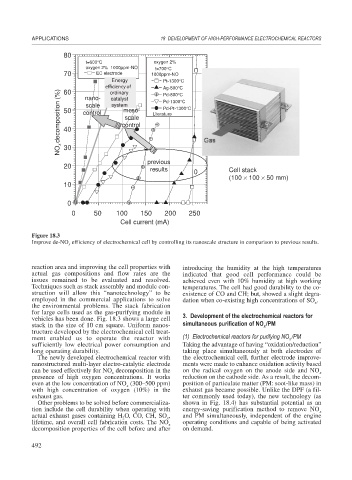
                  Figure 18.3
                  Improve de-NO efficiency of electrochemical cell by controlling its nanoscale structure in comparison to previous results.
                             x
                  reaction area and improving the cell properties with  introducing the humidity at the high temperatures
                  actual gas compositions and flow rates are the  indicated that good cell performance could be
                  issues remained to be evaluated and resolved.  achieved even with 10% humidity at high working
                  Techniques such as stack assembly and module con-  temperatures. The cell had good durability to the co-
                  struction will allow this “nanotechnology” to be  existence of CO and CH; but, showed a slight degra-
                  employed in the commercial applications to solve  dation when co-existing high concentrations of SO .
                                                                                                         x
                  the environmental problems. The stack fabrication
                  for large cells used as the gas-purifying module in
                  vehicles has been done. Fig. 18.3 shows a large cell  3. Development of the electrochemical reactors for
                  stack in the size of 10 cm square. Uniform nanos-  simultaneous purification of NO /PM
                                                                                          x
                  tructure developed by the electrochemical cell treat-
                  ment enabled us to operate the reactor with    (1) Electrochemical reactors for purifying NO /PM
                                                                                                 x
                  sufficiently low electrical power consumption and  Taking the advantage of having “oxidation/reduction”
                  long operating durability.                     taking place simultaneously at both electrodes of
                    The newly developed electrochemical reactor with  the electrochemical cell, further electrode improve-
                  nanostructured multi-layer electro-catalytic electrode  ments were made to enhance oxidation activity based
                  can be used effectively for NO decomposition in the  on the radical oxygen on the anode side and NO x
                                           x
                  presence of high oxygen concentrations. It works  reduction on the cathode side. As a result, the decom-
                  even at the low concentration of NO (300–500 ppm)  position of particulate matter (PM: soot-like mass) in
                                               x
                  with high concentration of oxygen (10%) in the  exhaust gas became possible. Unlike the DPF (a fil-
                  exhaust gas.                                   ter commonly used today), the new technology (as
                    Other problems to be solved before commercializa-  shown in Fig. 18.4) has substantial potential as an
                  tion include the cell durability when operating with  energy-saving purification method to remove NO x
                  actual exhaust gases containing H O, CO, CH, SO ,  and PM simultaneously, independent of the engine
                                              2
                                                            x
                  lifetime, and overall cell fabrication costs. The NO x  operating conditions and capable of being activated
                  decomposition properties of the cell before and after  on demand.
                  492

