


Page 460 - Offshore Electrical Engineering Manual
P. 460
Determining Safety Integrity Levels – Process  447


                     The SIL assessment meeting should consist of a chairperson usually qualified and
                  experienced in a safety-related discipline and representatives from design, maintenance
                  and operations. To save time, the software should be preprogrammed with component
                  failure data, but the sources of this data should be reviewed and agreed during the meeting.


                  DETERMINING SAFETY INTEGRITY LEVELS – PROCESS
                  When a process hazards analysis determines that an SIS is required, the level of risk
                  reduction afforded by the SIS and the target SIL has to be assigned. The effectiveness of
                  an SIS is described in terms of ‘the probability it will fail to perform its required func-
                  tion when it is called upon to do so’. This is its probability of failure on demand (PFD).
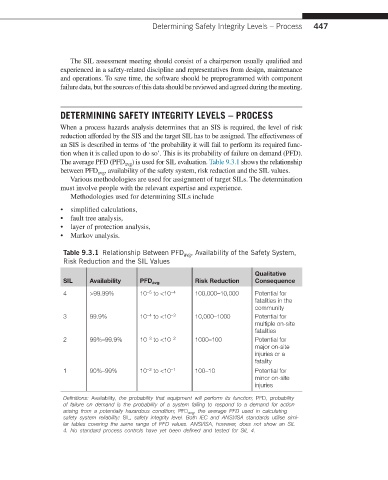
                  The average PFD (PFD ) is used for SIL evaluation. Table 9.3.1 shows the relationship
                                    avg
                  between PFD , availability of the safety system, risk reduction and the SIL values.
                            avg
                     Various methodologies are used for assignment of target SILs. The determination
                  must involve people with the relevant expertise and experience.
                     Methodologies used for determining SILs include

                   •   simplified calculations,
                   •   fault tree analysis,
                   •   layer of protection analysis,
                   •   Markov analysis.

                   Table 9.3.1  Relationship Between PFD avg , Availability of the Safety System,
                   Risk Reduction and the SIL Values

                                                                        Qualitative
                   SIL    Availability  PFD avg        Risk Reduction   Consequence
                   4      >99.99%       10  to <10 −4  100,000–10,000   Potential for
                                          −5
                                                                        fatalities in the
                                                                        community
                   3      99.9%         10  to <10 −3  10,000–1000      Potential for
                                          −4
                                                                        multiple on-site
                                                                        fatalities
                                          −3
                   2      99%–99.9%     10  to <10 −2  1000–100         Potential for
                                                                        major on-site
                                                                        injuries or a
                                                                        fatality
                   1      90%–99%       10  to <10 −1  100–10           Potential for
                                          −2
                                                                        minor on-site
                                                                        injuries
                   Definitions: Availability, the probability that equipment will perform its function; PFD, probability
                   of failure on demand is the probability of a system failing to respond to a demand for action
                   arising from a potentially hazardous condition; PFD avg , the average PFD used in calculating
                   safety system reliability; SIL, safety integrity level. Both IEC and ANSI/ISA standards utilise simi-
                   lar tables covering the same range of PFD values. ANSI/ISA, however, does not show an SIL
                   4. No standard process controls have yet been defined and tested for SIL 4.

