


Page 459 - Offshore Electrical Engineering Manual
P. 459
446    CHAPTER 3  Notes on Safety Integrity Level Assessment


                            Two requirements must be defined to achieve ‘functional safety’:

                          •   A clear definition of what the safety function has to achieve (i.e., what does it
                            do and how does it do it?) (derived from the hazard analysis)
                          •   The safety integrity requirement (probability of success, or likelihood of func-
                            tion being performed satisfactorily) (derived from the risk assessment)


                         SAFETY INSTRUMENTED SYSTEM
                         A safety instrumented system (SIS) is an instrumented system used to implement
                         one or more SIFs. An SIS may contain any combination of sensors, logic solvers and
                         final elements.


                         THE SAFETY INTEGRITY LEVEL ASSESSMENT PROCESS

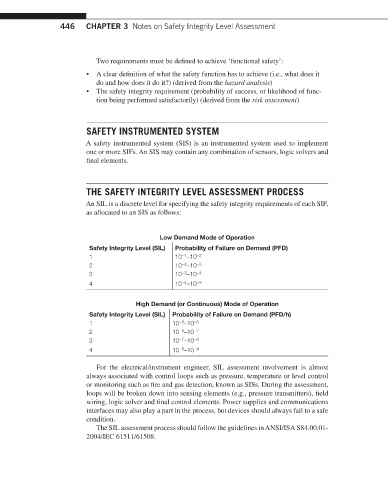
                         An SIL is a discrete level for specifying the safety integrity requirements of each SIF,
                         as allocated to an SIS as follows:


                                             Low Demand Mode of Operation
                          Safety Integrity Level (SIL)  Probability of Failure on Demand (PFD)
                                                    −1
                          1                       10 –10 −2
                                                    −2
                          2                       10 –10 −3
                                                    −3
                          3                       10 –10 −4
                                                    −4
                          4                       10 –10 −5
                                       High Demand (or Continuous) Mode of Operation
                          Safety Integrity Level (SIL)  Probability of Failure on Demand (PFD/h)
                          1                      10 –10 −6
                                                   −5
                          2                      10 –10 −7
                                                   −6
                                                   −7
                          3                      10 –10 −8
                          4                      10 –10 −9
                                                   −8
                            For the electrical/instrument engineer, SIL assessment involvement is almost
                         always associated with control loops such as pressure, temperature or level control
                         or monitoring such as fire and gas detection, known as SISs. During the assessment,
                         loops will be broken down into sensing elements (e.g., pressure transmitters), field
                         wiring, logic solver and final control elements. Power supplies and communications
                         interfaces may also play a part in the process, but devices should always fail to a safe
                         condition.
                            The SIL assessment process should follow the guidelines in ANSI/ISA S84.00.01-
                         2004/IEC 61511/61508.

