


Page 142 - Partition & Adsorption of Organic Contaminants in Environmental Systems
P. 142
SORPTION FROM WATER SOLUTION     133

                     120


                                    K oc
                    K oc  or K om  of CT  40  K om
                      80


                       0
                       0.4         0.6        0.8         1.0         1.2
                                      (O+N)/C Weight Ratio

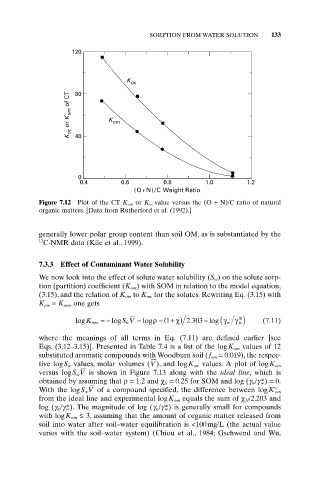
            Figure 7.12 Plot of the CT K om or K oc value versus the (O + N)/C ratio of natural
            organic matters. [Data from Rutherford et al. (1992).]


            generally lower polar group content than soil OM, as is substantiated by the
            13
             C-NMR data (Kile et al., 1999).
            7.3.3 Effect of Contaminant Water Solubility

            We now look into the effect of solute water solubility (S w) on the solute sorp-
            tion (partition) coefficient (K om) with SOM in relation to the model equation,
            (3.15), and the relation of K om to K ow for the solutes. Rewriting Eq. (3.15) with
            K pw = K om , one gets

                      logK om =-  logS V -  log - (1 + ) c  . 2 303  - log(g w g * w)  (7.11)
                                            r
                                    w
            where the meanings of all terms in Eq. (7.11) are defined earlier [see
            Eqs. (3.12–3.15)]. Presented in Table 7.4 is a list of the logK om values of 12
            substituted aromatic compounds with Woodburn soil (f om = 0.019), the respec-
                                           V
            tive logS w values, molar volumes ( ), and logK ow values. A plot of logK om
            versus logS w V  is shown in Figure 7.13 along with the  ideal line, which is
            obtained by assuming that r= 1.2 and c S = 0.25 for SOM and log (g w/g w *) = 0.
            With the logS w V  of a compound specified, the difference between logK° om
            from the ideal line and experimental logK om equals the sum of c H/2.203 and
            log (g w/g w *). The magnitude of log (g w/g w *) is generally small for compounds
            with logK om £ 3, assuming that the amount of organic matter released from
            soil into water after soil–water equilibration is <100mg/L (the actual value
            varies with the soil–water system) (Chiou et al., 1984; Gschwend and Wu,

