


Page 147 - Partition & Adsorption of Organic Contaminants in Environmental Systems
P. 147
138   CONTAMINANT SORPTION TO SOILS AND NATURAL SOLIDS

           correlation, which is relatively insensitive to solute polarity for the reasons
           stated in Chapter 5, the logK om versus logK ow (or logK om versus logS w)
           correlation is much more sensitive to solute polarity. In this sense, weakly
           polar octanol (or K ow) is not a good replicate model for relatively polar SOM
           (or K om).

           7.3.4 Behavior of PAHs versus Other Nonpolar Contaminants
           Although the K oc values of many nonpolar contaminants can be estimated with
           sufficient accuracy from their physicochemical properties, such as K ow or S w,
           the selection of a proper correlation for estimation is, however, complicated
           by the inconsistency of published correlations for selected nonpolar com-
           pounds on soils and sediments. A particular case in point is the inconsistency
           of the correlations for polycyclic aromatic hydrocarbons (PAHs) relative to
           other nonpolar organic compounds. For instance, with K oc = 1.85K om, the log
           K oc versus logK ow correlation established by Chiou et al. (1983) [i.e., Eq.
           (7.14)] for substituted aromatic compounds (primarily, chlorinated benzenes
           and PCBs) on a soil over the range logK ow = 2.11 to 5.62 gives

                                logK oc = 0.904logK ow - 0.512           (7.16)

           which is drastically different from a similar correlation established by
           Karickhoff et al. (1979) for mainly PAHs and their derivatives on river sedi-
           ments, where the compounds cover a comparable logK ow range (2.11 to 6.34).
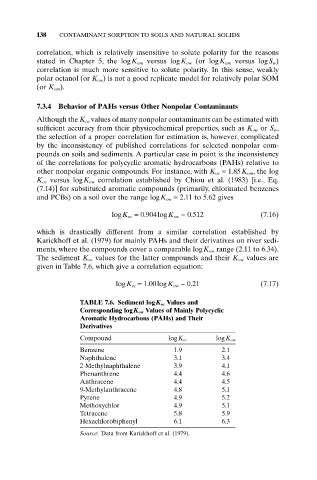
           The sediment K oc values for the latter compounds and their K ow values are
           given in Table 7.6, which give a correlation equation:

                                 logK oc = 1.00logK ow - 0.21            (7.17)

                       TABLE 7.6. Sediment logK oc Values and
                       Corresponding logK ow Values of Mainly Polycyclic
                       Aromatic Hydrocarbons (PAHs) and Their
                       Derivatives
                       Compound                 logK oc      logK ow
                       Benzene                   1.9           2.1
                       Naphthalene               3.1           3.4
                       2-Methylnaphthalene       3.9           4.1
                       Phenanthrene              4.4           4.6
                       Anthracene                4.4           4.5
                       9-Methylanthracene        4.8           5.1
                       Pyrene                    4.9           5.2
                       Methoxychlor              4.9           5.1
                       Tetracene                 5.8           5.9
                       Hexachlorobiphenyl        6.1           6.3
                       Source: Data from Karickhoff et al. (1979).

