


Page 220 - Petroleum Geology
P. 220
197

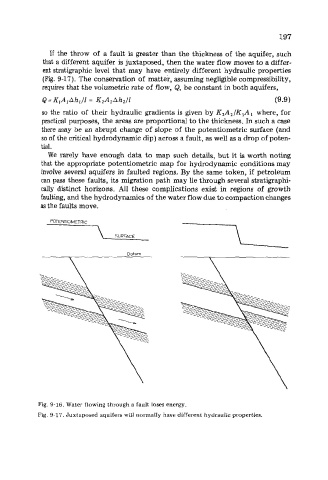
               If  the  throw  of  a fault is greater  than the thickness of  the aquifer, such
             that a different aquifer is juxtaposed, then the water flow moves to a differ-
             ent stratigraphic level that may  have  entirely different hydraulic  properties
             (Fig. 9-17). The conservation  of  matter, assuming negligible compressibility,
             requires that the volumetric rate of flow, Q, be constant in both aquifers,
             Q = K,A,Ah,/l = K,A,Ah,/l                                         (9 -9 1
             so  the ratio  of  their  hydraulic  gradients is given by K,A2/KlA1 where, for
             practical purposes,  the areas are proportional to the thickness. In such a case
             there may be an abrupt change of  slope of  the potentiometric  surface (and
             so of the critical hydrodynamic dip) across a fault, as well as a drop of poten-
             tial.
               We  rarely  have  enough data  to map  such details, but it is worth noting
             that the appropriate potentiometric  map for hydrodynamic conditions may
             involve  several aquifers in faulted regions. By  the same token, if  petroleum
             can pass these faults, its migration  path may lie through several stratigraphi-
             cally  distinct  horizons.  All  these  complications  exist  in  regions  of  growth
             faulting, and the hydrodynamics of the water flow due to compaction changes
             as the faults move.

               POTENTIOMETRIC

                                  SURFACE


            Fig. 9-16. Water flowing through a fault loses energy.
            Fig. 9-17. Juxtaposed aquifers will normally have different hydraulic properties.

