


Page 201 - Photoreactive Organic Thin Films
P. 201
HENN1NG MENZEL

                 appropriate chromophore, however; the structure of the film-forming matrix
                 must also be tailored to meet the requirements to keep the chromophores
                 photoactive. Moreover, it is possible to design the matrix in a way that boosts
                 the photoindueed changes caused by the photoreaction and enhances the
                 system's response. Photoisomerization, a very common mechanism used In
                 photoactive films, is a process requiring some free volume and is, therefore,
                 strongly influenced by the matrix. But reciprocally, it also affects the matrix
                 in its structure and order.
                    Langmulr-Blodgett-Kuhn (LBK) films are prepared by a dipping. process
                 in which naonolayers floating at the air/water interface are deposited on a
                 solid substrate. LBK films are highly ordered supramolecular assemblies. By
                 selection of the arnphiphilic molecules and adjustment of the transfer condi-
                 tions, the LBK technique offers extensive structural control and opens a way
                 to optimize matrices for photoactive dyes.


       6.2 OTHER DYES USED IN PHOTOACTIVE LBK FILMS

                 Several photoactive dyes have been incorporated into LBK films. Among
                 these, the class of photoisomerizing dyes, namely azobenzene derivatives, are
                 particularly versatile and have been investigated in great detail.
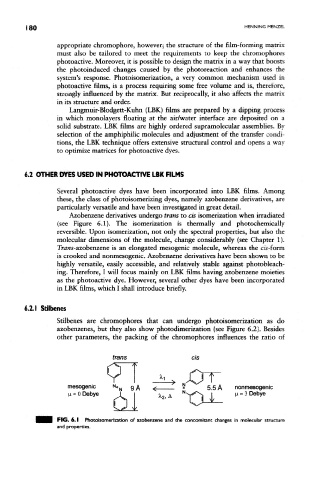
                    Azobenzene derivatives undergo trans to cis isomerization when irradiated
                 (see Figure 6.1). The isomerization is thermally and photochemkally
                 reversible. Upon isomerization, not only the spectral properties, but also the
                 molecular dimensions of the molecule, change considerably (see Chapter 1).
                 Traws-azobenzene is an elongated mesogenic molecule, whereas the ds-form
                 is crooked and nonmesogenic. Azobenzene derivatives have been shown to be
                 highly versatile, easily accessible, and relatively stable against photobleach-
                 ing. Therefore, I will focus mainly on LBK films having azobenzene moieties
                 as the photoactive dye. However, several other dyes have been incorporated
                 in LBK films, which I shall introduce briefly.


       6.2.1 Stilbenes
                 Stilbenes are chromophores that can undergo photoisomerization as do
                 azobenzenes, but they also show photodimerization (see Figure 6.2). Besides
                 other parameters, the packing of the chromophores influences the ratio of


                                 trans                   cis


                    mesogenic    N« N g^     ^        jj     5,5 A   nonmesogenic
                    (j. = 0 Debye


                 FIG. 6.1 Photoisomerization of azobenzene and the concomitant changes in molecular structure
                 and properties.

