


Page 205 - Photoreactive Organic Thin Films
P. 205
HENNING MENZEL

                 such as in densely packed LBK films, they are not fulfilled. The optical
                 properties of the chromophore depend on the dense packing in the LBK film
                 (see Section 6.3.2} and are changed when increasing amounts of ds-isotner
                 alter the packing of the chromophores, In this case, all spectroscopic methods
                 for determining the dsltrans ratio will fail. Besides spectroscopy, electro-
                 chemical methods can be employed to determine the dsltrans ratio in LBK
                 films. The a's-isomer can be reduced at significantly greater anodic potential
                 than the trans-isomer, this gives rise to a corresponding peak in the cyclic
                 voltammetry experiment, and the amount of c/s-isomer then can be calculated
                 from either the cathodic or the anodic charge. The total number of chro-
                 mophores can be calculated from the transfer conditions in the LBK experi-
                                                                         21
                 ment. It is even possible to use this method for actinometry.  It was by
                 employing this method that it was found that only 19% of chromophore 7
                 can be isomerized in LBK films. 18


       6.3.2 Aggregation
                 As mentioned previously, the interactions of the chromophores with extended
                 Ti-systems in densely packed solids like LBK films significantly influence the
                 optical properties. In particular, the aggregation causes a significant peak
                 shift, the direction and extent of which depends on the number of aggregated
                 chromophores and their distance from each other in the aggregate.
                 Furthermore, a particular influence on the extent and direction of the peak
                 shift is found for the orientation of the chromophores to each other i.e., the
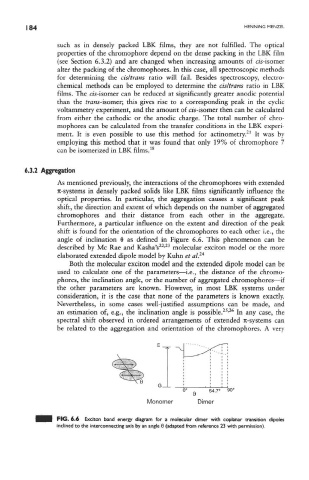
                 angle of inclination 6 as defined in Figure 6.6. This phenomenon can be
                                               22 23
                 described by Me Rae and Kasha's '  molecular exciton model or the more
                                                           24
                 elaborated extended dipole model by Kuhn et al.
                     Both the molecular exciton model and the extended dipole model can be
                 used to calculate one of the parameters — i.e., the distance of the chromo-
                 phores, the inclination angle, or the number of aggregated chromophores — if
                 the other parameters are known. However, in most LBK systems under
                 consideration, it is the case that none of the parameters is known exactly.
                 Nevertheless, in some cases well- justified assumptions can be made, and
                                                                  25 26
                 an estimation of, e.g., the inclination angle is possible. '  In any case, the
                 spectral shift observed in ordered arrangements of extended 7C-systems can
                 be related to the aggregation and orientation of the chromophores. A very


                 FIG. 6.6 Exciton band energy diagram for a molecular dimer with coplanar transition dipoles
                 inclined to the interconnecting axis by an angle 0 (adapted from reference 23 with permission).

