


Page 207 - Photoreactive Organic Thin Films
P. 207
186                                                              HENNING MENZEL

                        60
                                                        335
                        50 -
                                                        330
                        40 -
                      £
                      I 3°
                      CD                                325
                      CL
                      « 20 H
                        10 -                            320
                         o -
                          0.00 0.25 0.50 0.75 1.00 1.25 1.50 1.75
                                                 2
                                Area per Amphiphile [nm ]
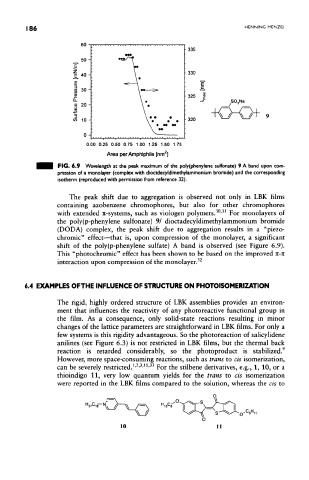
                 FIG. 6.9  Wavelength at the peak maximum of the poly(phenylene sulfonate) 9 A band upon com-
                 pression of a monolayer (complex with dioctdecyldimethylammonium bromide) and the corresponding
                 isotherm (reproduced with permission from reference 32).

                     The peak shift due to aggregation is observed not only in LBK films
                 containing azobenzene chromophores, but also for other chromophores
                                                                30 31
                 with extended Tt-systems, such as viologen polymers. '  For monolayers of
                 the poly(p-phenylene sulfonate) 91 dioctadecyldimethylammonium bromide
                 (DODA) complex, the peak shift due to aggregation results in a "piezo-
                 chromic" effect—that is, upon compression of the monolayer, a significant
                 shift of the poly(p-phenylene sulfate) A band is observed (see Figure 6.9).
                 This "photochromic" effect has been shown to be based on the improved n-n
                 interaction upon compression of the monolayer. 32


        6.4 EXAMPLES OFTHE INFLUENCE OF STRUCTURE ON PHOTOISOMERIZATION

                 The rigid, highly ordered structure of LBK assemblies provides an environ-
                 ment that influences the reactivity of any photoreactive functional group in
                 the film. As a consequence, only solid-state reactions resulting in minor
                 changes of the lattice parameters are straightforward in LBK films. For only a
                 few systems is this rigidity advantageous. So the photoreaction of salicylidene
                 anilines (see Figure 6.3) is not restricted in LBK films, but the thermal back
                                                                                    9
                 reaction is retarded considerably, so the photoproduct is stabilized.
                 However, more space-consuming reactions, such as trans to cis isomerization,
                                        1 2 3 11 33
                 can be severely restricted. ' ' ' '  For the stilbene derivatives, e.g., 1, 10, or a
                 thioindigo 11, very low quantum yields for the trans to cis isomerization
                 were reported in the LBK films compared to the solution, whereas the cis to


                                    10

