


Page 204 - Photoreactive Organic Thin Films
P. 204
6. PHOTOISOMERiZATION IN LANGMUIR-BLODGETT-KUHN STRUCTURES               183


                                     OMe
                                                                     OMe

                                        OMe
                                                                         OMe


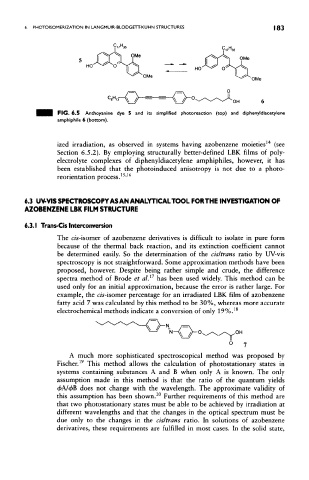
               FIG. 6.5 Anthoyanine dye 5 and its simplified photoreaction (top) and diphenyldiacetytene
               amphiphile 6 (bottom).


                                                                             14
               ized irradiation, as observed in systems having azobenzene moieties  (see
               Section 6.5.2). By employing structurally better-defined LBK films of poly-
               electrolyte complexes of diphenyldiacetylene amphiphiles, however, it has
               been established that the photoinduced anisotropy is not due to a photo-
                                  15 16
               reorientation process. '


      6.3 UV-VIS SPECTROSCOPY AS AN ANALYTICAL TOOL FORTHE INVESTIGATION OF
      AZOBENZENE LBK FILM STRUCTURE

      6.3.1 Trans-Cis Interconversion

               The c/s-isomer of azobenzene derivatives is difficult to isolate in pure form
               because of the thermal back reaction, and its extinction coefficient cannot
               be determined easily. So the determination of the dsltrans ratio by UV-vis
               spectroscopy is not straightforward. Some approximation methods have been
               proposed, however. Despite being rather simple and crude, the difference
                                          17
               spectra method of Erode et al.  has been used widely. This method can be
               used only for an initial approximation, because the error is rather large. For
               example, the ds-isomer percentage for an irradiated LBK film of azobenzene
               fatty acid 7 was calculated by this method to be 30%, whereas more accurate
                                                                   18
               electrochemical methods indicate a conversion of only 19%.


                   A much more sophisticated spectroscopical method was proposed by
                      19
               Fischer.  This method allows the calculation of photostationary states in
               systems containing substances A and B when only A is known. The only
               assumption made in this method is that the ratio of the quantum yields
               <£A/<£B does not change with the wavelength. The approximate validity of
                                            20
               this assumption has been shown.  Further requirements of this method are
               that two photostationary states must be able to be achieved by irradiation at
               different wavelengths and that the changes in the optical spectrum must be
               due only to the changes in the cis/trans ratio. In solutions of azobenzene
               derivatives, these requirements are fulfilled in most cases. In the solid state,

