


Page 203 - Photoreactive Organic Thin Films
P. 203
132                                                             HENNING MENZEL


                                                 hv
                                         COOH                                  COOH


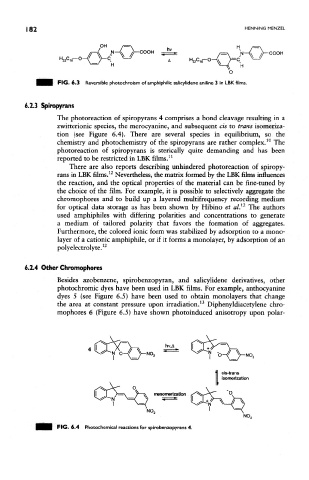
                 FIG. 6.3  Reversible photochroism of amphiphilic saiicylidene aniline 3 in LBK films.


       6.2.3 Spiropyrans
                 The photoreaction of spiropyrans 4 comprises a bond cleavage resulting in a
                 zwitterionic species, the merocyanine, and subsequent cis to trans isomeriza-
                 tion (see Figure 6.4). There are several species in equilibrium, so the
                                                                               10
                 chemistry and photochemistry of the spiropyrans are rather complex.  The
                 photoreaction of spiropyrans is sterically quite demanding and has been
                                                  11
                 reported to be restricted in LBK films.
                    There are also reports describing unhindered photoreaction of spiropy-
                                12
                 rans in LBK films.  Nevertheless, the matrix formed by the LBK films influences
                 the reaction, and the optical properties of the material can be fine-tuned by
                 the choice of the film. For example, it is possible to selectively aggregate the
                 chromophores and to build up a layered multifrequency recording medium
                                                                        u
                 for optical data storage as has been shown by Hibino et al.  The authors
                 used amphiphiles with differing polarities and concentrations to generate
                 a medium of tailored polarity that favors the formation of aggregates.
                 Furthermore, the colored ionic form was stabilized by adsorption to a mono-
                 layer of a cationic amphiphile, or if it forms a monolayer, by adsorption of an
                              12
                 polyelectrolyte.

       6.2.4 Other Chromophores
                 Besides azobenzene, spirobenzopyran, and saiicylidene derivatives, other
                 photochromic dyes have been used in LBK films. For example, anthocyanine
                 dyes 5 (see Figure 6.5) have been used to obtain monolayers that change
                                                           13
                 the area at constant pressure upon irradiation.  Diphenyldiacetyiene chro-
                 mophores 6 (Figure 6.5) have shown photoinduced anisotropy upon polar-


                                                                        NO,
                 FIG. 6.4 Photochemical reactions for spirobenzopyrans 4.

