


Page 210 - Photoreactive Organic Thin Films
P. 210
6. PHOTOISOMERIZATION IN LANGMUIR-BLODGETT-KUHN STRUCTURES                189


                                 r          ^ ^               ^•i r
                                      ^ /"        ^ *^  ^1 ^
                                                           <
                                   Q.    a.    O.    Q.    Q.
                                         2           s     5
                                   Q     o     O     o     O    gas
                                             r
                                 WrWQr* YBr*i!®?5 1 v3 f!?j water

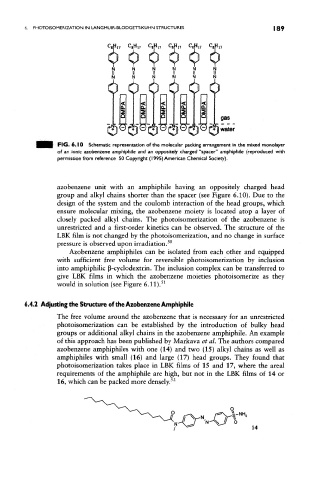
                FIG. 6.10 Schematic representation of the molecular packing arrangement in the mixed monolayer
                of an ionic azobenzene amphiphile and an oppositely charged "spacer" amphiphiie (reproduced with
                permission from reference 50 Copyright (1995) American Chemical Society).


                azobenzene unit with an amphiphile having an oppositely charged head
                group and alkyl chains shorter than the spacer (see Figure 6.10). Due to the
                design of the system and the coulomb interaction of the head groups, which
                ensure molecular mixing, the azobenzene moiety is located atop a layer of
                closely packed alkyl chains. The photoisomerization of the azobenzene is
                unrestricted and a first-order kinetics can be observed. The structure of the
                LBK film is not changed by the photoisomerization, and no change in surface
                pressure is observed upon irradiation. 50
                    Azobenzene amphiphiles can be isolated from each other and equipped
                with sufficient free volume for reversible photoisomerization by inclusion
                into amphiphilic (i-cyclodextrin. The inclusion complex can be transferred to
                give LBK films in which the azobenzene moieties photoisomerize as they
                would in solution (see Figure 6.II). 51

      6.4.2 Adjusting the Structure of the Azobenzene Amphiphile

                The free volume around the azobenzene that is necessary for an unrestricted
                photoisomerization can be established by the introduction of bulky head
                groups or additional alkyl chains in the azobenzene amphiphile. An example
                of this approach has been published by Markava et al. The authors compared
                azobenzene amphiphiles with one (14) and two (15) alkyl chains as well as
                amphiphiles with small (16) and large (17) head groups. They found that
                photoisomerization takes place in LBK films of 15 and 17, where the areal
                requirements of the amphiphile are high, but not in the LBK films of 14 or
                16, which can be packed more densely. 52

