


Page 215 - Photoreactive Organic Thin Films
P. 215
194                                                             HENNING MENZEL


                         A                  B                  C
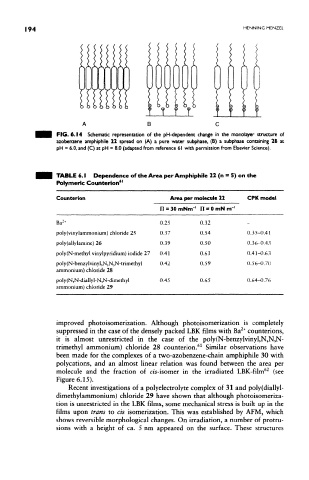
                 FIG. 6.14 Schematic representation of the pH-dependent change in the monolayer structure of
                 azobenzene amphiphile 22 spread on (A) a pure water subphase, (B) a subphase containing 28 at
                 pH = 6.0, and (C) at pH = 8.0 (adapted from reference 61 with permission from Elsevter Science).


                 TABLE 6.1 Dependence of the Area per Amphiphile 22 (n = 5) on the
                 Polymeric Counterfoil 61

                 Counterion                        Area per molecule 22  CPK model


                   2
                 Ba *                           0.25        0.32         _
                 poly(vinylammonium) chloride 25  0.37      0.54         0.35-0.41
                 poly(allylamine) 26            0.39        0.50         0.36-0.43
                 poly(N-methyl vinylpyridium) iodide 27  0.41  0.61      0.41-0.63
                 poly(N-benzylvinyl,N,N,N-trimethyl  0.42   0.59         0.56-0.70
                 ammonium) chloride 28
                 poly(N,N-diallyl-N,N-dimethyl  0.45        0.65         0.64-0.76
                 ammonium) chloride 29


                 improved photoisomerization. Although photoisomerization is completely
                                                                        2+
                 suppressed in the case of the densely packed LBK films with Ba  counterions,
                 it is almost unrestricted in the case of the poly(N-benzylvinyl,N,N,N-
                                                           61
                 trimethyl ammonium) chloride 28 counterion.  Similar observations have
                 been made for the complexes of a two-azobenzene-chain amphiphile 30 with
                 polycations, and an almost linear relation was found between the area per
                                                                              62
                 molecule and the fraction of ds-isomer in the irradiated LBK-film  (see
                 Figure 6.15).
                     Recent investigations of a polyelectrolyte complex of 31 and poly(diallyl-
                 dimethylammonium) chloride 29 have shown that although photoisomeriza-
                 tion is unrestricted in the LBK films, some mechanical stress is built up in the
                 films upon trans to cis isomerization. This was established by AFM, which
                 shows reversible morphological changes. On irradiation, a number of protru-
                 sions with a height of ca. 5 nm appeared on the surface. These structures

