


Page 220 - Photoreactive Organic Thin Films
P. 220
6, PHOTO1SOMERIZATION IN IANGMUIR-BLODGETT-KUHN STRUCTURES


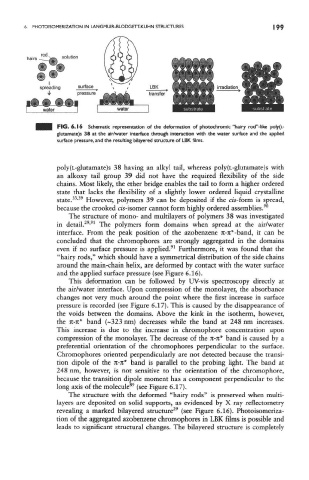
                FIG. 6.16 Schematic representation of the deformation of photoehromic "hairy rod"-like pofy(t-
                gtutamate)s 38 at the air/water interface through interaction with the water surface and the applied
                surface pressure, and the resulting bilayered structure of LBK films.


                poly(L-glutamate)s 38 having an alkyl tail, whereas poly(L-glutamate)s with
                an alkoxy tail group 39 did not have the required flexibility of the side
                chains. Most likely, the ether bridge enables the tail to form a higher ordered
                state that lacks the flexibility of a slightly lower ordered liquid crystalline
                    33 39
                state. '  However, polymers 39 can be deposited if the os-form is spread,
                because the crooked ds-isomer cannot form highly ordered assemblies. 90
                   The structure of mono- and multilayers of polymers 38 was investigated
                        29 91
                in detail. '  The polymers form domains when spread at the air/water
                interface. From the peak position of the azobenzene 7t-7C*-band, it can be
                concluded that the chromophores are strongly aggregated in the domains
                                                 91
                even if no surface pressure is applied.  Furthermore, it was found that the
                "hairy rods," which should have a symmetrical distribution of the side chains
                around the main-chain helix, are deformed by contact with the water surface
                and the applied surface pressure (see Figure 6.16).
                   This deformation can be followed by UV-vis spectroscopy directly at
                the air/water interface. Upon compression of the monolayer, the absorbance
                changes not very much around the point where the first increase in surface
                pressure is recorded (see Figure 6.17). This is caused by the disappearance of
                the voids between the domains. Above the kink in the isotherm, however,
                the n~n* band (~323 nm) decreases while the band at 248 nm increases,
                This increase is due to the increase in chromophore concentration upon
                compression of the monolayer. The decrease of the n-n* band is caused by a
                preferential orientation of the chromophores perpendicular to the surface.
                Chromophores oriented perpendicularly are not detected because the transi-
                tion dipole of the n-n* band is parallel to the probing light. The band at
                248 nm, however, is not sensitive to the orientation of the chromophore,
                because the transition dipole moment has a component perpendicular to the
                                     89
                long axis of the molecule  (see Figure 6.17).
                   The structure with the deformed "hairy rods" is preserved when multi-
                layers are deposited on solid supports, as evidenced by X ray reflectometry
                                                  29
                revealing a marked bilayered structure  (see Figure 6.16). Photoisomeriza-
                tion of the aggregated azobenzene chromophores in LBK films is possible and
                leads to significant structural changes. The bilayered structure is completely

