


Page 225 - Photoreactive Organic Thin Films
P. 225
204                                                              HENN1NG HENZEL


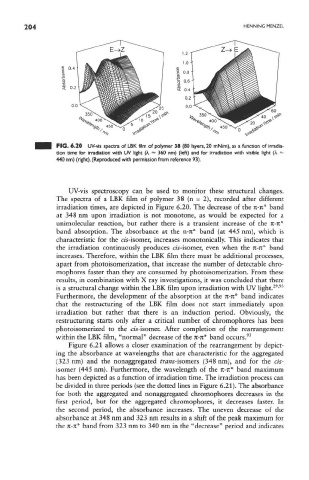
                 FIG. 6.20  UV-vis spectra of LBK film of polymer 38 (80 layers, 20 mN/m), as a function of irradia-
                 tion time for irradiation with UV light (A, = 360 nm) (left) and for irradiation with visible light (X ==
                 440 nm) (right). (Reproduced with permission from reference 93).


                     UV-vis spectroscopy can be used to monitor these structural changes.
                 The spectra of a LBK film of polymer 38 (n = 2), recorded after different
                 irradiation times, are depicted in Figure 6.20. The decrease of the n-n* band
                 at 348 nm upon irradiation is not monotone, as would be expected for a
                 unimolecular reaction, but rather there is a transient increase of the n-n*
                 band absorption. The absorbance at the n-n* band (at 445 nm), which is
                 characteristic for the as-isomer, increases monotonically. This indicates that
                 the irradiation continuously produces c/s-isomer, even when the n-n* band
                 increases. Therefore, within the LBK film there must be additional processes,
                 apart from photoisomerization, that increase the number of detectable chro-
                 mophores faster than they are consumed by photoisomerization. From these
                 results, in combination with X ray investigations, it was concluded that there
                                                                                 29 93
                 is a structural change within the LBK film upon irradiation with UV light. '
                 Furthermore, the development of the absorption at the n-n* band indicates
                 that the restructuring of the LBK film does not start immediately upon
                 irradiation but rather that there is an induction period. Obviously, the
                 restructuring starts only after a critical number of chromophores has been
                 photoisomerized to the c/s-isomer. After completion of the rearrangement
                 within the LBK film, "normal" decrease of the n-n* band occurs. 93
                     Figure 6.21 allows a closer examination of the rearrangement by depict-
                 ing the absorbance at wavelengths that are characteristic for the aggregated
                 (323 nm) and the nonaggregated trans-isomeis (348 nm), and for the c/s-
                 isomer (445 nm). Furthermore, the wavelength of the n-n* band maximum
                 has been depicted as a function of irradiation time. The irradiation process can
                 be divided in three periods (see the dotted lines in Figure 6.21). The absorbance
                 for both the aggregated and nonaggregated chromophores decreases in the
                 first period, but for the aggregated chromophores, it decreases faster. In
                 the second period, the absorbance increases. The uneven decrease of the
                 absorbance at 348 nm and 323 nm results in a shift of the peak maximum for
                 the n-n* band from 323 nm to 340 nm in the "decrease" period and indicates

