


Page 228 - Photoreactive Organic Thin Films
P. 228
6  PHOTOISOMERIZATION IN LANGMUIR-BLODGETT-KUHN STRUCTURES               207


                             X  1.64 •  fi ^  n  r ,^_^ \
                             Q)
                               1.62 •
                             "i 1.60-         \            v^=
                             n      n             v.     ^^
                             2 1.58-  *      "  """• •— zzL-zn^
                             a)
                             a: 1.56 •
                                    n v       '
                               •1 f^A .
                                        initial      CIS        trans
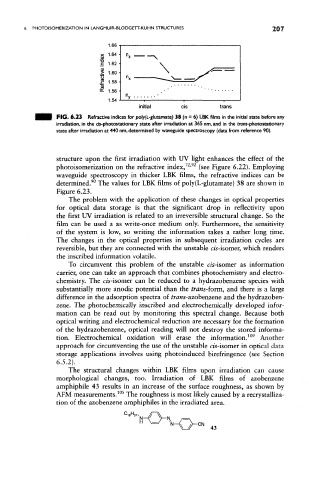
                FIG. 6.23  Refractive indices for poly(L-giutamate) 38 (n = 6) LBK films in the initial state before any
                irradiation, in the cis-photostationary state after irradiation at 365 nm, and in the mins-photostationary
                state after irradiation at 440 nm, determined by waveguide spectroscopy (data from reference 90).


                structure upon the first irradiation with UV light enhances the effect of the
                                                      72 92
                photoisomerization on the refractive index, '  (see Figure 6.22). Employing
                waveguide spectroscopy in thicker LBK films, the refractive indices can be
                          90
                determined.  The values for LBK films of poly(L-glutamate) 38 are shown in
                Figure 6.23.
                   The problem with the application of these changes in optical properties
                for optical data storage is that the significant drop in reflectivity upon
                the first UV irradiation is related to an irreversible structural change. So the
                film can be used a as write-once medium only. Furthermore, the sensitivity
                of the system is low, so writing the information takes a rather long time.
                The changes in the optical properties in subsequent irradiation cycles are
                reversible, but they are connected with the unstable c/s-isomer, which renders
                the inscribed information volatile.
                   To circumvent this problem of the unstable ds-isomer as information
                carrier, one can take an approach that combines photochemistry and electro-
                chemistry. The ds-isomer can be reduced to a hydrazobenzene species with
                substantially more anodic potential than the trans-form, and there is a large
                difference in the adsorption spectra of £ra«s-azobenzene and the hydrazoben-
                zene. The photochemically inscribed and electrochemically developed infor-
                mation can be read out by monitoring this spectral change. Because both
                optical writing and electrochemical reduction are necessary for the formation
                of the hydrazobenzene, optical reading will not destroy the stored informa-
                tion. Electrochemical oxidation will erase the information. 109  Another
                approach for circumventing the use of the unstable ds-isomer in optical data
                storage applications involves using photoinduced birefringence (see Section
                6.5.2).
                   The structural changes within LBK films upon irradiation can cause
                morphological changes, too. Irradiation of LBK films of azobenzene
                amphiphile 43 results in an increase of the surface roughness, as shown by
                                  105
                AFM measurements.    The roughness is most likely caused by a recrystalliza-
                tion of the azobenzene amphiphiles in the irradiated area.


                                                             43

