


Page 230 - Photoreactive Organic Thin Films
P. 230
6. PHOTOISOMERIZATION IN LANGMUIR-BLODGETT-KUHN STRUCTURES                 209


                                                                     frans-isomer


                     Transition Dipole      _. . . _, .... .         _
                              p
                                             Electric Field Vector   Reoriented
                                                                    Chromophore
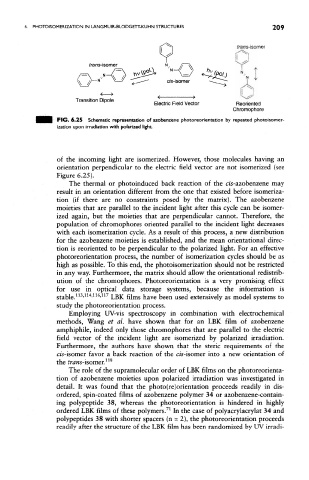
                FIG. 6.25  Schematic representation of azobenzene photoreorientation by repeated photoisomer-
                ization upon irradiation with polarized light.


                of the incoming light are isomerized. However, those molecules having an
                orientation perpendicular to the electric field vector are not isomerized (see
                Figure 6.25).
                   The thermal or photoinduced back reaction of the ds-azobenzene may
                result in an orientation different from the one that existed before isomeriza-
                tion (if there are no constraints posed by the matrix). The azobenzene
                moieties that are parallel to the incident light after this cycle can be isomer-
                ized again, but the moieties that are perpendicular cannot. Therefore, the
                population of chromophores oriented parallel to the incident light decreases
                with each isomerization cycle. As a result of this process, a new distribution
                for the azobenzene moieties is established, and the mean orientational direc-
                tion is reoriented to be perpendicular to the polarized light. For an effective
                photoreorientation process, the number of isomerization cycles should be as
                high as possible. To this end, the photoisomerization should not be restricted
                in any way. Furthermore, the matrix should allow the orientational redistrib-
                ution of the chromophores. Photoreorientation is a very promising effect
                for use in optical data storage systems, because the information is
                     113 114 116 117
                stable. ' ' '   LBK films have been used extensively as model systems to
                study the photoreorientation process.
                   Employing UV-vis spectroscopy in combination with electrochemical
                methods, Wang et al. have shown that for an LBK film of azobenzene
                amphiphile, indeed only those chromophores that are parallel to the electric
                field vector of the incident light are isomerized by polarized irradiation.
                Furthermore, the authors have shown that the steric requirements of the
                ds-isomer favor a back reaction of the ds-isomer into a new orientation of
                        •
                1
                the trans-isomer. 118
                   The role of the supramolecular order of LBK films on the photoreorienta-
                tion of azobenzene moieties upon polarized irradiation was investigated in
                detail. It was found that the photo(re)orientation proceeds readily in dis-
                ordered, spin-coated films of azobenzene polymer 34 or azobenzene-contain-
                ing polypeptide 38, whereas the photoreorientation is hindered in highly
                                                71
                ordered LBK films of these polymers.  In the case of polyacrylacrylat 34 and
                polypeptides 38 with shorter spacers (n = 2), the photoreorientation proceeds
                readily after the structure of the LBK film has been randomized by UV irradi-

