


Page 229 - Photoreactive Organic Thin Films
P. 229
HENNSNG MENZEL
        208


                                               100 nm
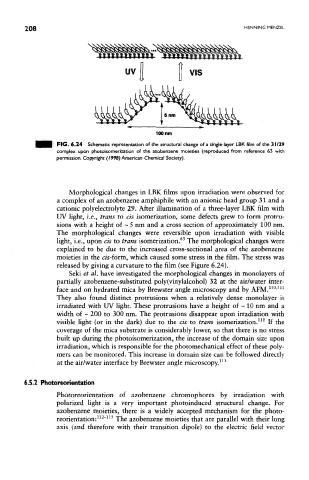
                  FIG. 6.24  Schematic representation of the structural change of a single-layer LBK film of the 31/29
                  complex upon photoisomerization of the azobenzene moieties (reproduced from reference 63 with
                  permission. Copyright (1998) American Chemical Society).


                     Morphological changes in LBK films upon irradiation were observed for
                  a complex of an azobenzene amphiphile with an anionic head group 31 and a
                  cationic polyelectrolyte 29. After illumination of a three-layer LBK film with
                  UV light, i.e., trans to cis isomerization, some defects grew to form protru-
                  sions with a height of ~ 5 nm and a cross section of approximately 100 nm.
                  The morphological changes were reversible upon irradiation with visible
                                                      63
                  light, i.e., upon cis to trans isomerization.  The morphological changes were
                  explained to be due to the increased cross-sectional area of the azobenzene
                  moieties in the as-form, which caused some stress in the film. The stress was
                  released by giving a curvature to the film (see Figure 6.24).
                      Seki et al. have investigated the morphological changes in monolayers of
                  partially azobenzene-substituted poly(vinylalcohol) 32 at the air/water inter-
                                                                                 110 111
                  face and on hydrated mica by Brewster angle microscopy and by AFM. '
                  They also found distinct protrusions when a relatively dense rnonolayer is
                  irradiated with UV light. These protrusions have a height of -10 nm and a
                  width of ~ 200 to 300 nm. The protrusions disappear upon irradiation with
                                                                              110
                  visible light (or in the dark) due to the cis to trans isomerization.  If the
                  coverage of the mica substrate is considerably lower, so that there is no stress
                  built up during the photoisomerization, the increase of the domain size upon
                  irradiation, which is responsible for the photomechanical effect of these poly-
                  mers can be monitored. This increase in domain size can be followed directly
                  at the air/water interface by Brewster angle microscopy. 111


         6.5.2 Photoreorientation
                  Photoreorientation of azobenzene chromophores by irradiation with
                  polarized light is a very important photoinduced structural change. For
                  azobenzene moieties, there is a widely accepted mechanism for the photo-
                              112 115
                  reorientation: "  The azobenzene moieties that are parallel with their long
                  axis (and therefore with their transition dipole) to the electric field vector

