


Page 224 - Photoreactive Organic Thin Films
P. 224
6. PHOTOISOMERIZATION !N LANGMUIR-BLODGETT-KUHN STRUCTURES                203

                                        102
                (intramolecular aggregates).  Due to the stronger interactions of the two
                peptide rings in the cis-form, the thermal back reaction is slower than in
                model azobenzene. So, irradiation with UV light results in nearly 100%
                ds-isomer, as has been shown by NMR. 102
                   These photoresponsive peptides form stable monolayers at the air/water
                        103
                interface,  the structure of which depends on the isomerization of the
                azobenzene. Photoisomerization, therefore, induces changes in the structure,
                and with that an increase in the areal requirements at constant surface pres-
                sure. As confirmed by UV-vis spectroscopy, LBK films of these peptide mono-
                layers deposited on quartz glass also retain the ability to isomerize.
                   There are several examples of photoisomerization of azobenzene moieties
                                                            29 68 70 73 104 105
                in LBK films that cause order-disorder transitions, ' ' ' ' '  and similar
                results and interpretations were found for different polymers (34, 35, 38).
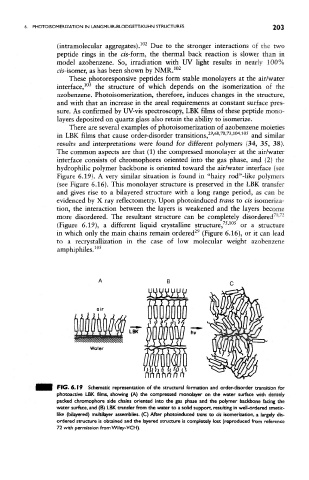
                The common aspects are that (1) the compressed monolayer at the air/water
                interface consists of chromophores oriented into the gas phase, arid (2) the
                hydrophilic polymer backbone is oriented toward the air/water interface (see
                Figure 6.19). A very similar situation is found in "hairy rod "-like polymers
                (see Figure 6.16). This monolayer structure is preserved in the LBK transfer
                and gives rise to a bilayered structure with a long range period, as can be
                evidenced by X ray reflectometry. Upon photoinduced trans to as isomeriza-
                tion, the interaction between the layers is weakened and the layers become
                                                                                70 72
                more disordered. The resultant structure can be completely disordered '
                                                                 75 105
                (Figure 6.19), a different liquid crystalline structure, '  or a structure
                                                        29
                in which only the main chains remain ordered  (Figure 6.16), or it can lead
                to a recrystallization in the case of low molecular weight azobenzene
                amphiphiles. 105


                              nm     LBK
                              i.^^,,.
                          Water


                FIG. 6.19 Schematic representation of the structural formation and order-disorder transition for
                photoactive LBK films, showing (A) the compressed monolayer on the water surface with densely
                packed chromophore side chains oriented into the gas phase and the polymer backbone facing the
                water surface, and (B) LBK transfer from the water to a solid support, resulting in well-ordered smetic-
                like (bilayered) multilayer assemblies. (C) After photoinduced trans to as isomerization, a largely dis-
                ordered structure is obtained and the layered structure is completely lost (reproduced from reference
                72 with permission from Wiley-VCH).

