


Page 227 - Photoreactive Organic Thin Films
P. 227
206                                                             HEMMING MENZEL

                 angles, but there is a certain angle at which the resonance conditions for the
                 excitation of surface plasmons are fulfilled. If the metal layer is very thin, the
                 resonance conditions are influenced by the material present at the back side
                 of the metal layer; in particular, the resonance conditions are sensitive to the
                 refractive index n z (perpendicular to the surface) of the surrounding medium.
                 The trans to cis isomerization in photoactive LBK films results in a change
                 of the refractive index, and therefore, the photoisomerization results in a
                 change of the resonance conditions. Irradiated and nonirradiated areas can be
                 distinguished with high lateral resolution with this method. The use of
                 photoactive LBK films as material and surface plasmon microscopy as read-
                 out technique have been suggested for application in optical data storage. 46
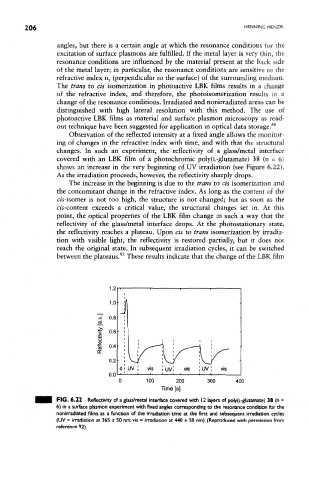
                     Observation of the reflected intensity at a fixed angle allows the monitor-
                 ing of changes in the refractive index with time, and with that the structural
                 changes. In such an experiment, the reflectivity of a glass/metal interface
                 covered with an LBK film of a photochromic poly(L-glutamate) 38 (n = 6)
                 shows an increase in the very beginning of UV irradiation (see Figure 6.22),
                 As the irradiation proceeds, however, the reflectivity sharply drops.
                     The increase in the beginning is due to the trans to cis isomerization and
                 the concomitant change in the refractive index. As long as the content of the
                 as-isomer is not too high, the structure is not changed; but as soon as the
                 as-content exceeds a critical value, the structural changes set in. At this
                 point, the optical properties of the LBK film change in such a way that the
                 reflectivity of the glass/metal interface drops. At the photostationary state,
                 the reflectivity reaches a plateau. Upon cis to trans isomerization by irradia-
                 tion with visible light, the reflectivity is restored partially, but it does not
                 reach the original state. In subsequent irradiation cycles, it can be switched
                                    92
                 between the plateaus.  These results indicate that the change of the LBK film


                                 1.2
                                 1.0

                             "5"  0.8
                              CO
                             -t 0.6
                              <D
                             •§ °- 4
                             01
                                 0.2

                                 0.0
                                            100      200      300     400
                                                Time [s]
                 FIG. 6.22  Reflectivity of a glass/metal interface covered with 12 layers of poly(t-glutamate) 38 (n =
                 6) in a surface plasmon experiment with fixed angles corresponding to the resonance condition for the
                 nonirradiated films as a function of the irradiation time at the first and subsequent irradiation cycles
                 (UV = irradiation at 365 ± 50 nm; vis = irradiation at 440 ± 50 nm). (Reproduced with permission from
                 reference 92).

