


Page 232 - Photoreactive Organic Thin Films
P. 232
6. PHOTOISOMERIZATION IN LANGMUIR-BLODGETT-KUHN STRUCTURES               211


                the use of the difference in the UV spectra due to the trans to as isomeriza-
                tion for read-out of the inscribed information. More sophisticated read-out
                techniques, such as surface piasmon microscopy, have been developed to min-
                imize the sensitivity problems of this approach. Another problem that arises
                from trans to as photoisomerization in optical data storage is the transient
                nature of the stored information because of the unstable os-isomer. It has
                been suggested that the combination of photoisomerization and electrochemi-
                                                                       109
                cal reduction of the os-isomer could overcome this problem.  The most
                promising approach for optical data storage, however, is based on photo-
                induced birefringence as a consequence of photorientation due to repeated
                photoisomerization of the chromophores. LBK films have been used as
                models for investigating the underlying mechanism of the photoreorientation,
                but only spin-coating films have the potential to be used in technical
                applications,
                   An example of tailoring the properties of photochromic moieties employ-
                ing the LBK technique to obtain a material suitable for multifrequency
                                                                n
                optical data storage has been proposed by Hibino et aL  The authors investi-
                gated a number of spirobenzopyrans showing J-aggregation that differed
                based on their substitution and the matrix. By tailoring these parameters,
                they created a layered system in which the dye for each layer has a very nar-
                row adsorption band with a position slightly different from that in all other
                layers. Up to ten different layers were deposited. The photoreaction shows a
                nonlinear dependency on the light intensity. Therefore, it is possible to write
                and nondestructively read at the same wavelength as long as the intensity of
                the read laser is low.

      6.6.2 Sensors
                                                                                 122
                Thin organic films have frequently been suggested for sensor applications,
                The aim is to find an appropriate combination of functional units in a
                supramolecular assembly such that an external stimulus can be transferred


                                                                      45
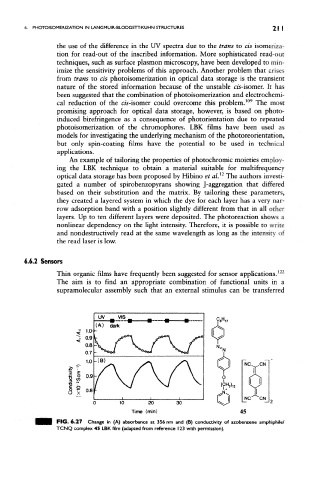
                FIG. 6.27  Change in (A) absorbance at 356 nm and (B) conductivity of azobenzene amphiphile/
                TCNQ complex 45 LBK film (adapted from reference 123 with permission).

