


Page 231 - Photoreactive Organic Thin Films
P. 231
2 | 0                                                           HENNING HENZEL


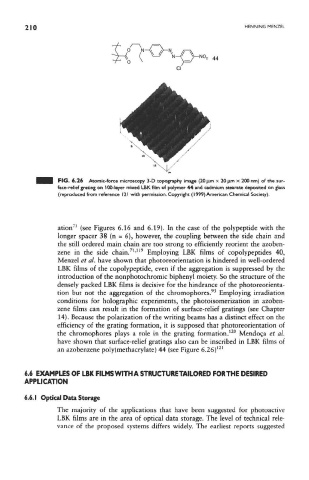
                 FIG. 6,26  Atomic-force microscopy 3-D topography image (20 ^im x 20 fim x 200 ran) of the sur-
                 face-relief grating on 100-layer mixed LBK film of polymer 44 and cadmium stearate deposited on glass
                 (reproduced from reference 121 with permission. Copyright (1999) American Chemical Society).


                     71
                 ation  (see Figures 6.16 and 6.19). In the case of the polypeptide with the
                 longer spacer 38 (n = 6), however, the coupling between the side chain and
                 the still ordered main chain are too strong to efficiently reorient the azoben-
                                      71 119
                 zene in the side chain. '  Employing LBK films of copolypeptides 40,
                 Menzel et al. have shown that photoreorientation is hindered in well-ordered
                 LBK films of the copolypeptide, even if the aggregation is suppressed by the
                 introduction of the nonphotochromic biphenyl moiety. So the structure of the
                 densely packed LBK films is decisive for the hindrance of the photoreorienta-
                                                              93
                 tion but not the aggregation of the chromophores,  Employing irradiation
                 conditions for holographic experiments, the photoisomerization in azoben-
                 zene films can result in the formation of surface-relief gratings (see Chapter
                 14), Because the polarization of the writing beams has a distinct effect on the
                 efficiency of the grating formation, it is supposed that photoreorientation of
                                                                   120
                 the chromophores plays a role in the grating formation.  Mendo^a et al.
                 have shown that surface-relief gratings also can be inscribed in LBK films of
                                                                121
                 an azobenzene poly(methacrylate) 44 (see Figure 6.26)


       6.6 EXAMPLES OF LBK FILMS WITH A STRUCTURE TAILORED FORTHE DESIRED
       APPLICATION

       6.6.1 Optical Data Storage
                 The majority of the applications that have been suggested for photoactive
                 LBK films are in the area of optical data storage. The level of technical rele-
                 vance of the proposed systems differs widely. The earliest reports suggested

