


Page 223 - Photoreactive Organic Thin Films
P. 223
202                                                              HENNING MENZEL

                 reported an example of a structural change that takes place in an LBK film of
                                                                             101
                 a double-chain azobenzene amphiphile complexed with polyviologen.  With
                 repeated isomerization cycles, the tilt angle of the azobenzene moieties
                 increases significantly. Upon storage in the dark, however, the original chro
                 mophore orientation—almost perpendicular to the substrate—was restored.
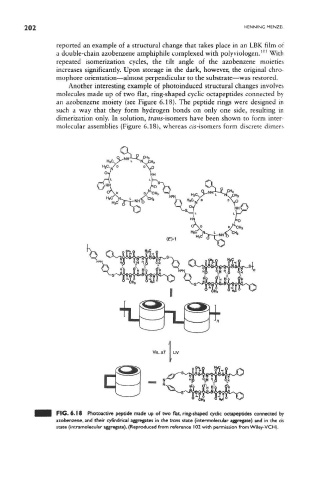
                    Another interesting example of photoinduced structural changes involves
                 molecules made up of two flat, ring-shaped cyclic octapeptides connected by
                 an azobenzene moiety (see Figure 6.18). The peptide rings were designed in
                 such a way that they form hydrogen bonds on only one side, resulting in
                 dimerization only. In solution, fraws-isomers have been shown to form inter-
                 molecular assemblies (Figure 6,18), whereas ds-isomers form discrete dimers


                 FIG. 6* 18 Photoactive peptide made up of two fiat, ring-shaped cyclic octapeptides connected by
                 azobenzene, and their cylindrical aggregates in the trans state (intermolecular aggregate) and in the as
                 state (intramolecular aggregate). (Reproduced from reference 102 with permission from Wiley-VCH).

