


Page 221 - Photoreactive Organic Thin Films
P. 221
200                                                              HENNING MENZEL


                                                                              n-n" band
                                                                              323 nm

                                                                        transition
                                                                        dipole

                                                                       <——>    248 nm
                                                                         4/   transition

                           0.20    0.25     0.30    0.35
                                                  2
                               Area per Monomeric Unit [nm ]
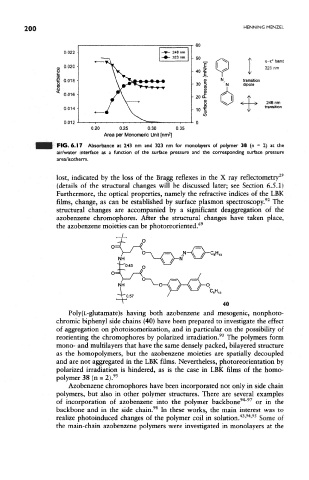
                 FIG. 6.17 Absorbance at 243 nm and 323 nm for monolayers of polymer 38 (n = 2) at the
                 air/water interface as a function of the surface pressure and the corresponding surface pressure
                 area/isotherm.

                 lost, indicated by the loss of the Bragg reflexes in the X ray reflectometry 29
                 (details of the structural changes will be discussed later; see Section 6.5.1)
                 Furthermore, the optical properties, namely the refractive indices of the LBK
                                                                              92
                 films, change, as can be established by surface plasmon spectroscopy.  The
                 structural changes are accompanied by a significant deaggregation of the
                 azobenzene chromophores. After the structural changes have taken place,
                 the azobenzene moieties can be photoreoriented. 69


                    Poly(L-glutamate)s having both azobenzene and mesogenic, nonphoto-
                 chromic biphenyl side chains (40) have been prepared to investigate the effect
                 of aggregation on photoisomerization, and in particular on the possibility of
                                                                 93
                 reorienting the chromophores by polarized irradiation.  The polymers form
                 mono- and multilayers that have the same densely packed, bilayered structure
                 as the homopolymers, but the azobenzene moieties are spatially decoupled
                 and are not aggregated in the LBK films. Nevertheless, photoreorientation by
                 polarized irradiation is hindered, as is the case in LBK films of the homo-
                                  93
                 polymer 38 (n = 2).
                    Azobenzene chromophores have been incorporated not only in side chain
                 polymers, but also in other polymer structures. There are several examples
                                                                       94 97
                 of incorporation of azobenzene into the polymer backbone "  or in the
                                             98
                 backbone and in the side chain.  In these works, the main interest was to
                                                                       43 94 95
                 realize photoinduced changes of the polymer coil in solution. ' '  Some of
                 the main-chain azobenzene polymers were investigated in monolayers at the

