


Page 217 - Photoreactive Organic Thin Films
P. 217
196                                                             HENNING MENZEL

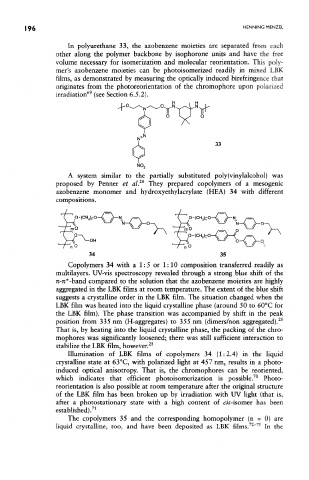
                     In polyurethane 33, the azobenzene moieties are separated from each
                 other along the polymer backbone by isophorone units and have the free
                 volume necessary for isomerization and molecular reorientation. This poly-
                 mer's azobenzene moieties can be photoisomerized readily in mixed LBK.
                 films, as demonstrated by measuring the optically induced birefringence that
                 originates from the photoreorientation of the chromophore upon polarized
                          69
                 irradiation  (see Section 6.5.2).


                                                                33


                     A system similar to the partially substituted poly(vinylalcohol) was
                                          2S
                 proposed by Penner et al.  They prepared copolymers of a mesogenic
                 azobenzene monomer and hydroxyethylacrylate (HEA) 34 with different
                 compositions.


                     Copolymers 34 with a 1:5 or 1:10 composition transferred readily as
                 multilayers. UV-vis spectroscopy revealed through a strong blue shift of the
                 n-n*-band compared to the solution that the azobenzene moieties are highly
                 aggregated in the LBK films at room temperature. The extent of the blue shift
                 suggests a crystalline order in the LBK film. The situation changed when the
                 LBK film was heated into the liquid crystalline phase (around 50 to 60°C for
                 the LBK film). The phase transition was accompanied by shift in the peak
                 position from 335 nm (H-aggregates) to 355 nm (dimers/non aggregated). 28
                 That is, by heating into the liquid crystalline phase, the packing of the chro-
                 mophores was significantly loosened; there was still sufficient interaction to
                 stabilize the LBK film, however. 28
                     Illumination of LBK films of copolymers 34 (1:2.4) in the liquid
                 crystalline state at 63°C, with polarized light at 457 nm, results in a photo-
                 induced optical anisotropy. That is, the chromophores can be reoriented,
                                                                           70
                 which indicates that efficient photoisomerization is possible.  Photo-
                 reorientation is also possible at room temperature after the original structure
                 of the LBK film has been broken up by irradiation with UV light (that is,
                 after a photostationary state with a high content of «s-isomer has been
                 established). 71
                    The copolymers 35 and the corresponding homopolymer (n = 0) are
                                                                          72 75
                 liquid crystalline, too, and have been deposited as LBK films. "  In the

