


Page 213 - Photoreactive Organic Thin Films
P. 213
192                                                             HENN1NG MENZEL


                                            Air
                                           Water H-N  , H-N  H-N    H-N
                                                   )=0   >=Q    /=0    >=0
                                                H-N  'H-N    H-N    -H-N
                                                   H     H       H     H

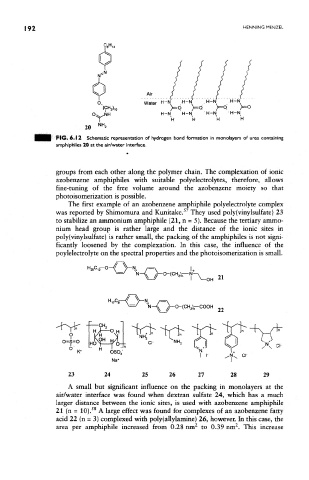
                 PIG. 6.12 Schematic representation of hydrogen bond formation in monolayers of urea containing
                 amphiphiles 20 at the air/water interface.


                 groups from each other along the polymer chain. The compiexation of ionic
                 azobenzene amphiphiles with suitable polyelectrolytes, therefore, allows
                 fine-tuning of the free volume around the azobenzene moiety so that
                 photoisomerization is possible.
                    The first example of an azobenzene amphiphile polyelectrolyte complex
                                                       57
                 was reported by Shimomura and Kunitake.  They used poly(vinylsulfate) 23
                 to stabilize an ammonium amphiphile (21, n = 5). Because the tertiary ammo-
                 nium head group is rather large and the distance of the ionic sites in
                 poly(vinylsulfate) is rather small, the packing of the amphiphiles is not signi-
                 ficantly loosened by the compiexation. In this case, the influence of the
                 poylelectrolyte on the spectral properties and the photoisomerization is small.


                                                 0-(CH 2) n— N-
                                                             -OH  21


                     23        24         25      26       27       28        29
                    A small but significant influence on the packing in monolayers at the
                 air/water interface was found when dextran sulfate 24, which has a much
                 larger distance between the ionic sites, is used with azobenzene amphiphile
                           58
                 21 (n = 10).  A large effect was found for complexes of an azobenzene fatty
                 acid 22 (n = 3) complexed with poly(allylamine) 26, however. In this case, the
                                                          2           2
                 area per amphiphile increased from 0.28 nm  to 0.39 nm . This increase

