


Page 243 - Photoreactive Organic Thin Films
P. 243
222                                    EUGENII KATZ.ANDREW N. SHIPWAY,AND ITAMARWILLNER


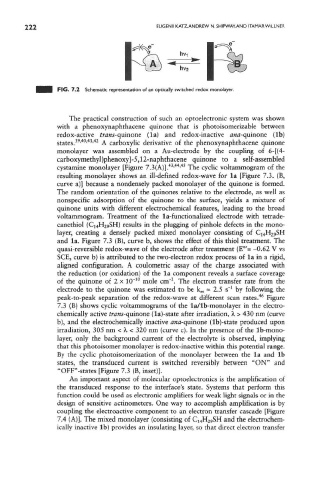
                 FIG. 7.2  Schematic representation of an optically switched redox monotayer.


                     The practical construction of such an optoelectronic system was shown
                 with a phenoxynaphthacene quinone that is photoisomerizable between
                 redox-active trans-quinone (la) and redox-inactive ana-qumone (Ib)
                       39 40 41 42
                 states. ' ' '  A carboxylic derivative of the phenoxynaphthacene quinone
                 monolayer was assembled on a Au-electrode by the coupling of 6-[(4-
                 carboxymethyl)phenoxy]-5,12-naphthacene quinone to a self-assembled
                                                  43 44 45
                 cystamine monolayer [Figure 7.3(A)]. ' '  The cyclic voltammogram of the
                 resulting monolayer shows an ill-defined redox-wave for la [Figure 7.3. (B,
                 curve a)] because a nondensely packed monolayer of the quinone is formed.
                 The random orientation of the quinones relative to the electrode, as well as
                 nonspecific adsorption of the quinone to the surface, yields a mixture of
                 quinone units with different electrochemical features, leading to the broad
                 voltammogram. Treatment of the la-functionalized electrode with tetrade-
                 canethiol (C^H^SH) results in the plugging of pinhole defects in the mono-
                 layer, creating a densely packed mixed monolayer consisting of C^H^SH
                 and la. Figure 7.3 (B), curve b, shows the effect of this thiol treatment. The
                                                                        0/
                 quasi-reversible redox-wave of the electrode after treatment (E = —0.62 V vs
                 SCE, curve b) is attributed to the two-electron redox process of la in a rigid,
                 aligned configuration. A coulometric assay of the charge associated with
                 the reduction (or oxidation) of the la component reveals a surface coverage
                                         10        2
                 of the quinone of 2 x 10~  mole cm" . The electron transfer rate from the
                                                                    4
                 electrode to the quinone was estimated to be k ct « 2.5 s"  by following the
                                                                             46
                 peak-to-peak separation of the redox-wave at different scan rates.  Figure
                 7.3 (B) shows cyclic voltammograms of the la/lb-monolayer in the electro-
                 chemically active tra«s-quinone (la)-state after irradiation, K > 430 nm (curve
                 b), and the electrochemically inactive ana-quinont (Ib)-state produced upon
                 irradiation, 305 nm < A- < 320 nm (curve c). In the presence of the Ib-mono-
                 layer, only the background current of the electrolyte is observed, implying
                 that this photoisomer monolayer is redox-inactive within this potential range.
                 By the cyclic photoisomerization of the monolayer between the la and Ib
                 states, the transduced current is switched reversibly between "ON" and
                  "OFF"-states [Figure 7.3 (B, inset)].
                     An important aspect of molecular optoelectronics is the amplification of
                 the transduced response to the interface's state. Systems that perform this
                 function could be used as electronic amplifiers for weak light signals or in the
                 design of sensitive actinometers. One way to accomplish amplification is by
                 coupling the electroactive component to an electron transfer cascade [Figure
                 7.4 (A)]. The mixed monolayer (consisting of C 14H 29SH and the electrochem-
                 icaliy inactive Ib) provides an insulating layer, so that direct electron transfer

