


Page 247 - Photoreactive Organic Thin Films
P. 247
226                                   EUGENIi KATZ.ANDREW N. SHIPWAY,AND ITAMARWiLlNER


                        B


                                         0.4 -0.2  0  0.2  0.4
                                            E / V (vs. SCE)
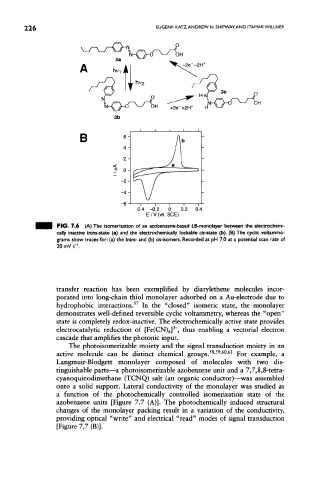
                 FIG. 7.6 (A) The isomerization of an azobenzene-based LB-monolayer between the electrochemi-
                 cally inactive trans-state (a) and the electrochemically lockable as-state (b). (B) The cyclic voltamrno-
                 grams show traces for: (a) the trans- and (b) cre-isomers. Recorded at pH 7.0 at a potential scan rate of
                 20 mV s-'.


                 transfer reaction has been exemplified by diarylethene molecules incor-
                 porated into long-chain thiol monolayer adsorbed on a Au-electrode due to
                                        57
                 hydrophobic interactions.  In the "closed" isomeric state, the monolayer
                 demonstrates well-defined reversible cyclic voltammetry, whereas the "open"
                 state is completely redox-inactive. The electrochemically active state provides
                                                   3
                 electrocatalytic reduction of [Fe(CN) 6] ~, thus enabling a vectorial electron
                 cascade that amplifies the photonic input.
                     The photoisomerizable moiety and the signal transduction moiety in an
                                                              58 59 60 61
                 active molecule can be distinct chemical groups. ' ' '  For example, a
                 Langmuir-Blodgett monolayer composed of molecules with two dis-
                 tinguishable parts—a photoisomerizable azobenzene unit and a 7,7,8,8-tetra-
                 cyanoquinodimethane (TCNQ) salt (an organic conductor)—was assembled
                 onto a solid support. Lateral conductivity of the monolayer was studied as
                 a function of the photochemically controlled isomerization state of the
                 azobenzene units [Figure 7.7 (A)]. The photochemically induced structural
                 changes of the monolayer packing result in a variation of the conductivity,
                 providing optical "write" and electrical "read" modes of signal transduction
                 [Figure 7.7 (B)].

