


Page 246 - Photoreactive Organic Thin Films
P. 246
7. ELECTRONIC AND OPTICAL TRANSDUCTION OF PHOTISOMERIZATION PROCESSES     225


                                    -20-
                                                             -0.4

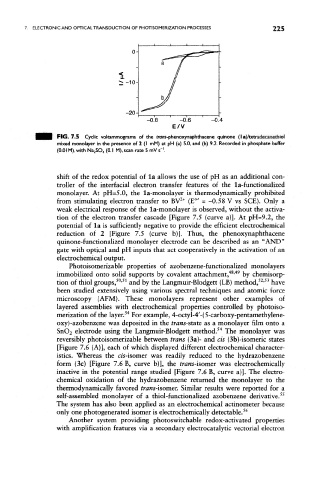
                FIG. 7.5 Cyclic voltammograms of the trans-phenoxynaphthacene quinone (la)/tetradecanethiol
                mixed monolayer in the presence of 2 (I mM) at pH (a) 5.0, and (b) 9.2. Recorded in phosphate buffer
                                               1
                (0.01M),with Na 2SO 4 (O.I M),scan rate 5 mV s' .


                shift of the redox potential of la allows the use of pH as an additional con-
                troller of the interfacial electron transfer features of the la-functionalized
                monolayer. At pH=5.0, the la-monolayer is thermodynamically prohibited
                                                         0/
                                                    2
                from stimulating electron transfer to BV * (E  = -0.58 V vs SCE). Only a
                weak electrical response of the la-monolayer is observed, without the activa-
                tion of the electron transfer cascade [Figure 7.5 (curve a)]. At pH=9.2, the
                potential of la is sufficiently negative to provide the efficient electrochemical
                reduction of 2 [Figure 7.5 (curve b)]. Thus, the phenoxynaphthacene
                quinone-functionalized monolayer electrode can be described as an "AND"
                gate with optical and pH inputs that act cooperatively in the activation of an
                electrochemical output.
                   Photoisomerizable properties of azobenzene-functionalized monolayers
                                                                   48 49
                immobilized onto solid supports by covalent attachment, '  by chemisorp-
                                 50 51                                     52 53
                tion of thiol groups, '  and by the Langmuir-Blodgett (LB) method, *  have
                been studied extensively using various spectral techniques and atomic force
                microscopy (AFM). These monolayers represent other examples of
                layered assemblies with electrochemical properties controlled by photoiso-
                                    54                    /
                merization of the layer.  For example, 4-octyl-4 -(5-carboxy-pentamethylene-
                oxy)-azobenzene was deposited in the ^raws-state as a monolayer film onto a
                                                               54
                SnO 2 electrode using the Langmuir-Blodgett method.  The monolayer was
                reversibly photoisomerizable between trans (3a)~ and cis (3b)-isomeric states
                [Figure 7.6 (A)], each of which displayed different electrochemical character-
                istics. Whereas the ds-isomer was readily reduced to the hydrazobenzene
                form (3c) [Figure 7.6 B, curve b)], the £ra«s-isomer was electrochemically
                inactive in the potential range studied [Figure 7.6 B, curve a)]. The electro-
                chemical oxidation of the hydrazobenzene returned the monolayer to the
                thermodynamically favored fnws-isomer. Similar results were reported for a
                                                                                 5
                self-assembled monolayer of a thiol-functionalized azobenzene derivative. ^
                The system has also been applied as an electrochemical actinometer because
                only one photogenerated isomer is electrochemically detectable. 56
                   Another system providing photoswitchable redox-activated properties
                with amplification features via a secondary electrocatalytic vectorial electron

