


Page 244 - Photoreactive Organic Thin Films
P. 244
7, ELECTRONIC AND OPTICAL TRANSDUCTION OF PHOTISOMERIZATION PROCESSES    223


                                                305 nm
                                                 <X<
                                                320 nm


                                                430 nm


                                    10

                                    5H


                                                           _ 1 a (trans)

                                  -10-
                                                             1b(ana)
                                  -15
                                      -0.8 -0.6 -0.4    -0.2
                                            E/V(vsSCE)
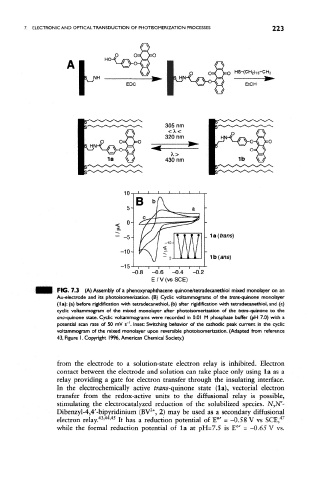
                FIG. 7.3 (A) Assembly of a phenoxynaphthacene quinone/tetradecanethiol mixed monolayer on an
                Au-electrode and its photoisomerization. (B) Cyclic voltammograms of the trans-quinone monolayer
                (la): (a) before rigidiflcation with tetradecanethiol, (b) after rigidiflcation with tetradecanethiol, and (c)
                cyclic voltammogram of the mixed monolayer after photoisomerization of the trans-quinone to the
                ono-quinone state. Cyclic voltammograms were recorded in 0.01 M phosphate buffer (pH 7,0) with a
                potential scan rate of 50 mV s~'. Inset: Switching behavior of the cathodic peak current in the cyclic
                voltammogram of the mixed monolayer upon reversible photoisomerization. (Adapted from reference
                43, Figure I.Copyright 1996, American Chemical Society.)


                from the electrode to a solution-state electron relay is inhibited. Electron
                contact between the electrode and solution can take place only using la as a
                relay providing a gate for electron transfer through the insulating interface.
                In the electrochemically active ifnws-quinone state (la), vectorial electron
                transfer from the redox-active units to the diffusional relay is possible,
                stimulating the electrocatalyzed reduction of the solubilized species. N,N'-
                                           2
                Dibenzyl-4,4'-bipyridinium (BV % 2) may be used as a secondary diffusional
                            43 44 45
                electron relay. ' '  It has a reduction potential of E°' = -0.58 V vs SCE, 47
                while the formal reduction potential of la at pH=7.5 is E°' = -0.65 V vs.

