


Page 248 - Photoreactive Organic Thin Films
P. 248
7. ELECTRONIC AND OPTICAL TRANSDUCTION OF PHOTISOMERIZATION PROCESSES    227


                        B     365 nm
                              436 nm
                                1.4


                                                                    40
                                                     t/min
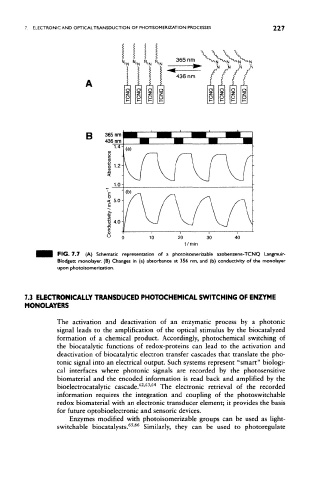
                FIG. 7.7 (A) Schematic representation of a photoisomerizable azobenzene-TCNQ Langmuir-
                Blodgett monolayer. (B) Changes in (a) absorbance at 356 nm, and (b) conductivity of the monolayer
                upon photoisomerization.


      7.3 ELECTRONICALLY TRANSDUCED PHOTOCHEMICAL SWITCHING OF ENZYME
      MONOLAYERS
                The activation and deactivation of an enzymatic process by a photonic
                signal leads to the amplification of the optical stimulus by the biocatalyzed
                formation of a chemical product. Accordingly, photochemical switching of
                the biocatalytic functions of redox-proteins can lead to the activation and
                deactivation of biocatalytic electron transfer cascades that translate the pho-
                tonic signal into an electrical output. Such systems represent "smart" biologi-
                cal interfaces where photonic signals are recorded by the photosensitive
                biomaterial and the encoded information is read back and amplified by the
                                        62 63 64
                bioelectrocatalytic cascade. ' '  The electronic retrieval of the recorded
                information requires the integration and coupling of the photoswitchable
                redox biomaterial with an electronic transducer element; it provides the basis
                for future optobioelectronic and sensoric devices.
                   Enzymes modified with photoisomerizable groups can be used as light-
                                     65 66
                switchable biocatalysts. '  Similarly, they can be used to photoregulate

