


Page 337 - Physical Principles of Sedimentary Basin Analysis
P. 337
10.1 Newton’s law of gravity                319

                                                                z
                           dV                                      r
                                        q
                                                                θ
                            r
                              θ             α
                                       s                        φ        y
                                                          x

                                   (a)                          (b)
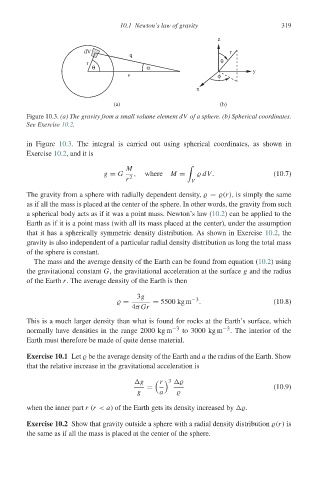
            Figure 10.3. (a) The gravity from a small volume element dV of a sphere. (b) Spherical coordinates.
            See Exercise 10.2.

            in Figure 10.3. The integral is carried out using spherical coordinates, as shown in
            Exercise 10.2, and it is
                                       M
                                 g = G   ,  where  M =      dV.                (10.7)
                                       r 2              V

            The gravity from a sphere with radially dependent density,   =  (r), is simply the same
            as if all the mass is placed at the center of the sphere. In other words, the gravity from such
            a spherical body acts as if it was a point mass. Newton’s law (10.2) can be applied to the
            Earth as if it is a point mass (with all its mass placed at the center), under the assumption
            that it has a spherically symmetric density distribution. As shown in Exercise 10.2,the
            gravity is also independent of a particular radial density distribution as long the total mass
            of the sphere is constant.
              The mass and the average density of the Earth can be found from equation (10.2)using
            the gravitational constant G, the gravitational acceleration at the surface g and the radius
            of the Earth r. The average density of the Earth is then

                                          3g
                                      =       = 5500 kg m −3 .                 (10.8)
                                        4πGr
            This is a much larger density than what is found for rocks at the Earth’s surface, which
            normally have densities in the range 2000 kg m −3  to 3000 kg m −3 . The interior of the
            Earth must therefore be made of quite dense material.

            Exercise 10.1 Let   be the average density of the Earth and a the radius of the Earth. Show
            that the relative increase in the gravitational acceleration is
                                                r
                                          g
   3
                                            =                                  (10.9)
                                          g     a
            when the inner part r (r < a) of the Earth gets its density increased by   .

            Exercise 10.2 Show that gravity outside a sphere with a radial density distribution  (r) is
            the same as if all the mass is placed at the center of the sphere.

