


Page 338 - Physical Principles of Sedimentary Basin Analysis
P. 338
320                      Gravity and gravity anomalies

                 Solution: The gravitational attraction dF onamass m from a small volume element dV
                 of the sphere with mass dM =   dV is

                                                     Gm dM

                                              dF =                                 (10.10)
                                                       q 2
                 where q is the distance to the volume element, see Figure 10.3. The distance to the center

                 of the sphere is s. The force from the small mass dF is directed parallel to the side q of
                 the triangle in Figure 10.3. The component of the gravity that is parallel to the line s is the

                 projection of dF on line s:
                                                  Gm dM
                                            dF =         cos α.                    (10.11)
                                                    q 2
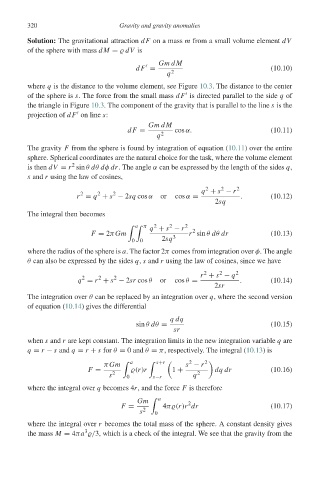
                 The gravity F from the sphere is found by integration of equation (10.11) over the entire
                 sphere. Spherical coordinates are the natural choice for the task, where the volume element
                             2
                 is then dV = r sin θ dθ dφ dr. The angle α can be expressed by the length of the sides q,
                 s and r using the law of cosines,
                                                                     2
                                                                 2
                                                                q + s − r 2
                               2    2   2
                              r = q + s − 2sq cos α  or  cos α =           .       (10.12)
                                                                    2sq
                 The integral then becomes
                                                       2
                                              a π
                                                   2
                                                  q + s − r 2
                                                              2
                                  F = 2πGm              3    r sin θ dθ dr         (10.13)
                                             0 0     2sq
                 where the radius of the sphere is a. The factor 2π comes from integration over φ. The angle
                 θ can also be expressed by the sides q, s and r using the law of cosines, since we have
                                                                 2
                                                                     2
                                                                r + s − q 2
                                2   2   2
                               q = r + s − 2sr cos θ  or  cos θ =          .       (10.14)
                                                                    2sr
                 The integration over θ can be replaced by an integration over q, where the second version
                 of equation (10.14) gives the differential
                                                        qdq
                                              sin θ dθ =                           (10.15)
                                                         sr
                 when s and r are kept constant. The integration limits in the new integration variable q are
                 q = r − s and q = r + s for θ = 0 and θ = π, respectively. The integral (10.13)is
                                                             2
                                      πGm     a      s+r     s − r 2
                                 F =          (r)r      1 +         dq dr          (10.16)
                                       s 2  0      s−r        q 2
                 where the integral over q becomes 4r, and the force F is therefore

                                               Gm     a      2
                                          F =         4π (r)r dr                   (10.17)
                                               s 2  0
                 where the integral over r becomes the total mass of the sphere. A constant density gives
                                 3
                 the mass M = 4πa  /3, which is a check of the integral. We see that the gravity from the

