


Page 340 - Physical Principles of Sedimentary Basin Analysis
P. 340
322                      Gravity and gravity anomalies

                 acceleration (10.6), because the potential is a scalar while the acceleration is a vector. Fur-
                 thermore, the acceleration is found from the gradient of the potential, g =−∇U,aswe
                 will soon see.

                 Exercise 10.3 Show that the potential from a spherical density distribution is the same as
                 if all the mass is placed at the center.
                 Solution: The sphere can be divided into a large (infinite) number of small (infinitesimal)
                 cells, and the potential for the entire sphere is the sum of the potentials from each cell. The
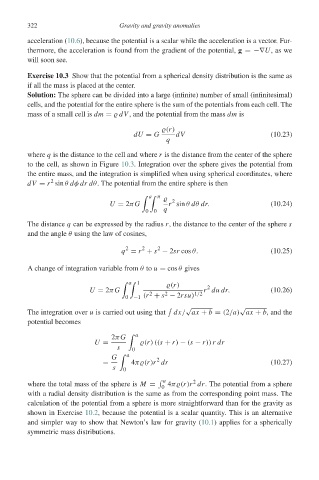
                 mass of a small cell is dm =   dV , and the potential from the mass dm is

                                                      (r)
                                              dU = G     dV                        (10.23)
                                                       q
                 where q is the distance to the cell and where r is the distance from the center of the sphere
                 to the cell, as shown in Figure 10.3. Integration over the sphere gives the potential from
                 the entire mass, and the integration is simplified when using spherical coordinates, where
                       2
                 dV = r sin θ dφ dr dθ. The potential from the entire sphere is then
                                                  a π

                                                        2
                                       U = 2πG         r sin θ dθ dr.              (10.24)
                                                 0 0 q
                 The distance q can be expressed by the radius r, the distance to the center of the sphere s
                 and the angle θ using the law of cosines,

                                                2
                                                    2
                                            2
                                          q = r + s − 2sr cos θ.                   (10.25)
                 A change of integration variable from θ to u = cos θ gives
                                            a 1
                                                        (r)
                                                                  2
                                  U = 2πG                        r du dr.          (10.26)
                                                  2
                                                      2
                                            0 −1 (r + s − 2rsu) 1/2
                                                            √             √

                 The integration over u is carried out using that  dx/ ax + b = (2/a) ax + b, and the
                 potential becomes
                                        2πG     a
                                   U =           (r) ((s + r) − (s − r))rdr
                                         s   0
                                        G     a     2
                                     =       4π (r)r dr                            (10.27)
                                        s  0
                                                      a
                                                              2
                 where the total mass of the sphere is M =  4π (r)r dr. The potential from a sphere
                                                     0
                 with a radial density distribution is the same as from the corresponding point mass. The
                 calculation of the potential from a sphere is more straightforward than for the gravity as
                 showninExercise 10.2, because the potential is a scalar quantity. This is an alternative
                 and simpler way to show that Newton’s law for gravity (10.1) applies for a spherically
                 symmetric mass distributions.

