


Page 344 - Physical Principles of Sedimentary Basin Analysis
P. 344
326                      Gravity and gravity anomalies

                                                n
                                                    Δg
                                                            S
                                   n                       h         n


                                                    Δg
                                                n
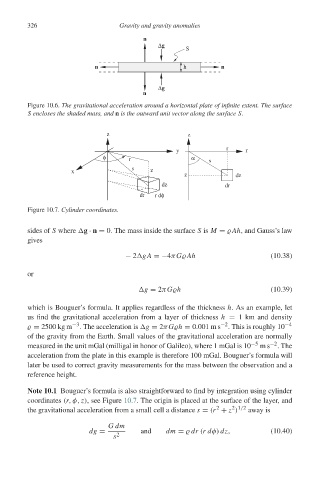
                 Figure 10.6. The gravitational acceleration around a horizontal plate of infinite extent. The surface
                 S encloses the shaded mass, and n is the outward unit vector along the surface S.


                                      z                     z
                                                                       r
                                                         y                  r
                                     φ      r                α    s
                                             s
                             x                    z
                                                           z             dz
                                                     dz               dr
                                               dr   r dφ
                 Figure 10.7. Cylinder coordinates.


                 sides of S where  g · n = 0. The mass inside the surface S is M =  Ah, and Gauss’s law
                 gives
                                            − 2 gA =−4πG Ah                        (10.38)

                 or

                                                g = 2πG h                          (10.39)

                 which is Bouguer’s formula. It applies regardless of the thickness h. As an example, let
                 us find the gravitational acceleration from a layer of thickness h = 1 km and density
                   = 2500 kg m −3 . The acceleration is  g = 2πG h = 0.001 m s −2 . This is roughly 10 −4
                 of the gravity from the Earth. Small values of the gravitational acceleration are normally
                 measured in the unit mGal (milligal in honor of Galileo), where 1 mGal is 10 −5  ms −2 .The
                 acceleration from the plate in this example is therefore 100 mGal. Bouguer’s formula will
                 later be used to correct gravity measurements for the mass between the observation and a
                 reference height.

                 Note 10.1 Bouguer’s formula is also straightforward to find by integration using cylinder
                 coordinates (r,φ, z), see Figure 10.7. The origin is placed at the surface of the layer, and
                                                                    2
                                                                        2 1/2
                 the gravitational acceleration from a small cell a distance s = (r + z )  away is
                                       Gdm
                                  dg =          and    dm =   dr (rdφ) dz,         (10.40)
                                        s 2

