


Page 349 - Physical Principles of Sedimentary Basin Analysis
P. 349
10.8 Gravity from a horizontal cylinder         331

                                  z                  z
                                         y
                                              x                      x
                                                          s   α
                                                            g    h
                                                   r
                                                            x


                                   (a)                    (b)
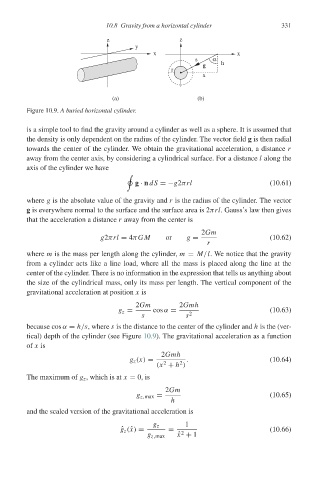
            Figure 10.9. A buried horizontal cylinder.

            is a simple tool to find the gravity around a cylinder as well as a sphere. It is assumed that
            the density is only dependent on the radius of the cylinder. The vector field g is then radial
            towards the center of the cylinder. We obtain the gravitational acceleration, a distance r
            away from the center axis, by considering a cylindrical surface. For a distance l along the
            axis of the cylinder we have
                                       #
                                         g · n dS =−g2πrl                     (10.61)

            where g is the absolute value of the gravity and r is the radius of the cylinder. The vector
            g is everywhere normal to the surface and the surface area is 2πrl. Gauss’s law then gives
            that the acceleration a distance r away from the center is
                                                           2Gm
                                g2πrl = 4πGM      or   g =                    (10.62)
                                                             r
            where m is the mass per length along the cylinder, m = M/l. We notice that the gravity
            from a cylinder acts like a line load, where all the mass is placed along the line at the
            center of the cylinder. There is no information in the expression that tells us anything about
            the size of the cylindrical mass, only its mass per length. The vertical component of the
            gravitational acceleration at position x is
                                         2Gm         2Gmh
                                     g z =    cos α =                         (10.63)
                                           s           s 2
            because cos α = h/s, where s is the distance to the center of the cylinder and h is the (ver-
            tical) depth of the cylinder (see Figure 10.9). The gravitational acceleration as a function
            of x is
                                                2Gmh
                                        g z (x) =      .                      (10.64)
                                                     2
                                                 2
                                               (x + h )
            The maximum of g z , which is at x = 0, is
                                                 2Gm
                                          g z,max =                           (10.65)
                                                   h
            and the scaled version of the gravitational acceleration is

                                              g z      1
                                     ˆ g z (ˆx) =  =  2                       (10.66)
                                             g z,max  ˆ x + 1

