


Page 351 - Physical Principles of Sedimentary Basin Analysis
P. 351
10.9 Gravity from a prism with rectangular cross-section  333


                               x     x 0                x 1    x 2
                                              x                         x
                                                z 1
                       z         dz
                               dx
                       z 0                      z 2

                        z                         z
                              (a)                        (b)
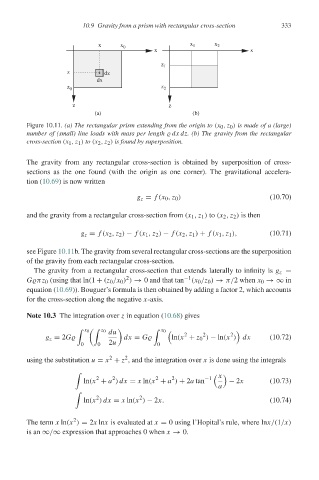
            Figure 10.11. (a) The rectangular prism extending from the origin to (x 0 , z 0 ) is made of a (large)
            number of (small) line loads with mass per length   dx dz. (b) The gravity from the rectangular
            cross-section (x 1 , z 1 ) to (x 2 , z 2 ) is found by superposition.

            The gravity from any rectangular cross-section is obtained by superposition of cross-
            sections as the one found (with the origin as one corner). The gravitational accelera-
            tion (10.69) is now written
                                          g z = f (x 0 , z 0 )                (10.70)

            and the gravity from a rectangular cross-section from (x 1 , z 1 ) to (x 2 , z 2 ) is then

                           g z = f (x 2 , z 2 ) − f (x 1 , z 2 ) − f (x 2 , z 1 ) + f (x 1 , z 1 ),  (10.71)

            see Figure 10.11b. The gravity from several rectangular cross-sections are the superposition
            of the gravity from each rectangular cross-section.
              The gravity from a rectangular cross-section that extends laterally to infinity is g z =
                                       2
            G πz 0 (using that ln(1 + (z 0 /x 0 ) ) → 0 and that tan −1 (x 0 /z 0 ) → π/2 when x 0 →∞ in
            equation (10.69)). Bouguer’s formula is then obtained by adding a factor 2, which accounts
            for the cross-section along the negative x-axis.
            Note 10.3 The integration over z in equation (10.68)gives

                                  du                   2    2      2
                           x 0  z 0             x 0

                 g z = 2G             dx = G       ln(x + z 0 ) − ln(x ) dx   (10.72)
                           0   0  2u           0
                                      2
                                  2
            using the substitution u = x + z , and the integration over x is done using the integrals
                                                                x


                                               2
                                                   2
                               2
                                   2
                           ln(x + a ) dx = x ln(x + a ) + 2a tan −1  − 2x     (10.73)
                                                                a

                               2          2
                           ln(x ) dx = x ln(x ) − 2x.                         (10.74)
                         2
            The term x ln(x ) = 2x lnx is evaluated at x = 0 using l’Hopital’s rule, where lnx/(1/x)
            is an ∞/∞ expression that approaches 0 when x → 0.

