


Page 353 - Physical Principles of Sedimentary Basin Analysis
P. 353
10.10 Gravity from a 2D polygonal body          335

                                 50
                                                   1
                                                   3
                                 40
                                                 2
                                dg [mGal]  20
                                 30


                                 10


                                  0
                                   0     2    4     6     8    10
                                             distance [km]
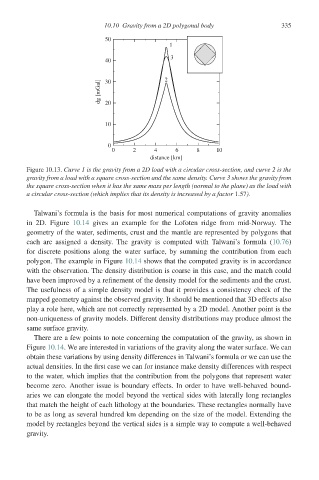
            Figure 10.13. Curve 1 is the gravity from a 2D load with a circular cross-section, and curve 2 is the
            gravity from a load with a square cross-section and the same density. Curve 3 shows the gravity from
            the square cross-section when it has the same mass per length (normal to the plane) as the load with
            a circular cross-section (which implies that its density is increased by a factor 1.57).

              Talwani’s formula is the basis for most numerical computations of gravity anomalies
            in 2D. Figure 10.14 gives an example for the Lofoten ridge from mid-Norway. The
            geometry of the water, sediments, crust and the mantle are represented by polygons that
            each are assigned a density. The gravity is computed with Talwani’s formula (10.76)
            for discrete positions along the water surface, by summing the contribution from each
            polygon. The example in Figure 10.14 shows that the computed gravity is in accordance
            with the observation. The density distribution is coarse in this case, and the match could
            have been improved by a refinement of the density model for the sediments and the crust.
            The usefulness of a simple density model is that it provides a consistency check of the
            mapped geometry against the observed gravity. It should be mentioned that 3D effects also
            play a role here, which are not correctly represented by a 2D model. Another point is the
            non-uniqueness of gravity models. Different density distributions may produce almost the
            same surface gravity.
              There are a few points to note concerning the computation of the gravity, as shown in
            Figure 10.14. We are interested in variations of the gravity along the water surface. We can
            obtain these variations by using density differences in Talwani’s formula or we can use the
            actual densities. In the first case we can for instance make density differences with respect
            to the water, which implies that the contribution from the polygons that represent water
            become zero. Another issue is boundary effects. In order to have well-behaved bound-
            aries we can elongate the model beyond the vertical sides with laterally long rectangles
            that match the height of each lithology at the boundaries. These rectangles normally have
            to be as long as several hundred km depending on the size of the model. Extending the
            model by rectangles beyond the vertical sides is a simple way to compute a well-behaved
            gravity.

