


Page 352 - Physical Principles of Sedimentary Basin Analysis
P. 352
334                      Gravity and gravity anomalies

                                    10.10 Gravity from a 2D polygonal body
                 Most 2D bodies can be quite accurately approximated by a polygon. The gravity at the
                 origin (0, 0) from a polygonal cross-section is found in a similar way to the gravity from
                 a 2D body with a rectangular cross-section. It is the integral of line loads that fills the
                 polygon

                                                        z
                                         g = 2G             dx dz                  (10.75)
                                                       2
                                                   A x + z 2
                 where dm =   dx dz is the mass per unit length in the y-direction, and where the density
                   is constant inside the area A.Note 10.4 shows that the gravity at the origin then becomes
                                 N
                                     b n    r n+1        −1  x n+1  −1  x n

                        g = 2G             ln    + a n tan      − tan              (10.76)
                                     2
                                    a + 1    r n           z n+1       z n
                                     n
                                n=1
                 when the polygon has N corners with coordinates (x n , z n ) anticlockwise around the
                                          2
                                               2 1/2
                 perimeter, and where r n = (x + z )  is the distance from the origin to the point n.
                                          n
                                               n
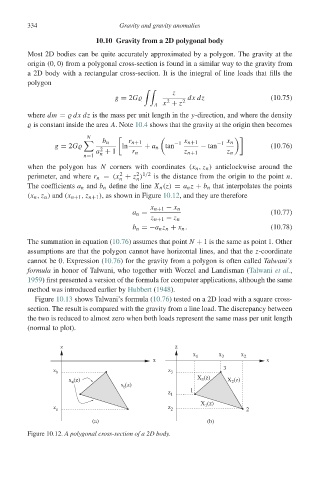
                 The coefficients a n and b n define the line X n (z) = a n z + b n that interpolates the points
                 (x n , z n ) and (x n+1 , z n+1 ), as shown in Figure 10.12, and they are therefore
                                                  x n+1 − x n
                                             a n =                                 (10.77)
                                                  z n+1 − z n
                                             b n =−a n z n + x n .                 (10.78)
                 The summation in equation (10.76) assumes that point N + 1 is the same as point 1. Other
                 assumptions are that the polygon cannot have horizontal lines, and that the z-coordinate
                 cannot be 0. Expression (10.76) for the gravity from a polygon is often called Talwani’s
                 formula in honor of Talwani, who together with Worzel and Landisman (Talwani et al.,
                 1959) first presented a version of the formula for computer applications, although the same
                 method was introduced earlier by Hubbert (1948).
                   Figure 10.13 shows Talwani’s formula (10.76) tested on a 2D load with a square cross-
                 section. The result is compared with the gravity from a line load. The discrepancy between
                 the two is reduced to almost zero when both loads represent the same mass per unit length
                 (normal to plot).


                          z                              z
                                                              x 1    x 3   x 2
                                                   x                              x
                        z b                            z 3            3
                                                               X (z)
                            x (z)                                 3    X (z)
                             a
                                          x (z)                         2
                                           b
                                                       z 1   1
                                                                X (z)
                        z a                            z 2       1          2
                                   (a)                            (b)
                 Figure 10.12. A polygonal cross-section of a 2D body.

