


Page 348 - Physical Principles of Sedimentary Basin Analysis
P. 348
330                      Gravity and gravity anomalies

                                                            1.0
                                  z
                                                            0.8
                                                       x
                                         g  α  g z
                                 h                        g   [−]   0.6
                                   α   r                  ^   z  0.4

                                                            0.2

                                                            0.0
                                                             −4   −2   0    2    4
                                                                      ^
                                                                      x [−]
                                    (a)                                (b)
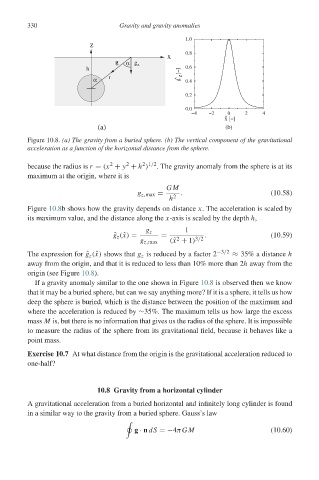
                 Figure 10.8. (a) The gravity from a buried sphere. (b) The vertical component of the gravitational
                 acceleration as a function of the horizontal distance from the sphere.

                                            2
                                       2
                                                2 1/2
                 because the radius is r = (x + y + h )  . The gravity anomaly from the sphere is at its
                 maximum at the origin, where it is
                                                       GM
                                               g z,max =  .                        (10.58)
                                                       h 2
                 Figure 10.8b shows how the gravity depends on distance x. The acceleration is scaled by
                 its maximum value, and the distance along the x-axis is scaled by the depth h,
                                                            1
                                                 g z
                                        ˆ g z (ˆx) =  =          .                 (10.59)
                                                         2
                                                        x
                                                g z,max  (ˆ + 1) 3/2
                 The expression for ˆg z (ˆx) shows that g z is reduced by a factor 2 −3/2  ≈ 35% a distance h
                 away from the origin, and that it is reduced to less than 10% more than 2h away from the
                 origin (see Figure 10.8).
                   If a gravity anomaly similar to the one shown in Figure 10.8 is observed then we know
                 that it may be a buried sphere, but can we say anything more? If it is a sphere, it tells us how
                 deep the sphere is buried, which is the distance between the position of the maximum and
                 where the acceleration is reduced by ∼35%. The maximum tells us how large the excess
                 mass M is, but there is no information that gives us the radius of the sphere. It is impossible
                 to measure the radius of the sphere from its gravitational field, because it behaves like a
                 point mass.

                 Exercise 10.7 At what distance from the origin is the gravitational acceleration reduced to
                 one-half?


                                    10.8 Gravity from a horizontal cylinder
                 A gravitational acceleration from a buried horizontal and infinitely long cylinder is found
                 in a similar way to the gravity from a buried sphere. Gauss’s law
                                            #
                                              g · n dS =−4πGM                      (10.60)

