


Page 343 - Physical Principles of Sedimentary Basin Analysis
P. 343
10.5 Bouguer’s formula for gravity due to a horizontal layer  325


                                              r n  n

                                                dS

                                        d Ω

                                                 1


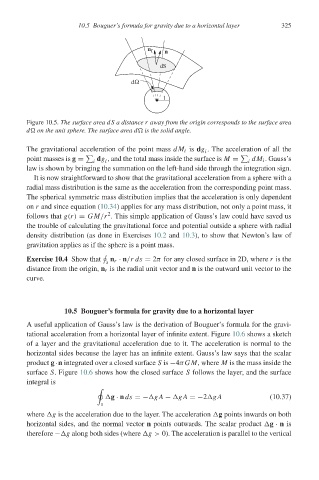
            Figure 10.5. The surface area dS a distance r away from the origin corresponds to the surface area
            d  on the unit sphere. The surface area d  is the solid angle.

            The gravitational acceleration of the point mass dM i is dg . The acceleration of all the
                                                            i

            point masses is g =  dg , and the total mass inside the surface is M =  dM i . Gauss’s
                              i  i                                      i
            law is shown by bringing the summation on the left-hand side through the integration sign.
              It is now straightforward to show that the gravitational acceleration from a sphere with a
            radial mass distribution is the same as the acceleration from the corresponding point mass.
            The spherical symmetric mass distribution implies that the acceleration is only dependent
            on r and since equation (10.34) applies for any mass distribution, not only a point mass, it
                                  2
            follows that g(r) = GM/r . This simple application of Gauss’s law could have saved us
            the trouble of calculating the gravitational force and potential outside a sphere with radial
            density distribution (as done in Exercises 10.2 and 10.3), to show that Newton’s law of
            gravitation applies as if the sphere is a point mass.

                                $
            Exercise 10.4 Show that  n r · n/rds = 2π for any closed surface in 2D, where r is the
                                 s
            distance from the origin, n r is the radial unit vector and n is the outward unit vector to the
            curve.


                      10.5 Bouguer’s formula for gravity due to a horizontal layer
            A useful application of Gauss’s law is the derivation of Bouguer’s formula for the gravi-
            tational acceleration from a horizontal layer of infinite extent. Figure 10.6 shows a sketch
            of a layer and the gravitational acceleration due to it. The acceleration is normal to the
            horizontal sides because the layer has an infinite extent. Gauss’s law says that the scalar
            product g·n integrated over a closed surface S is −4πGM, where M is the mass inside the
            surface S. Figure 10.6 shows how the closed surface S follows the layer, and the surface
            integral is
                               #
                                  g · n ds =− gA −  gA =−2 gA                 (10.37)
                                s
            where  g is the acceleration due to the layer. The acceleration  g points inwards on both
            horizontal sides, and the normal vector n points outwards. The scalar product  g · n is
            therefore − g along both sides (where  g > 0). The acceleration is parallel to the vertical

