


Page 339 - Physical Principles of Sedimentary Basin Analysis
P. 339
10.2 Potential energy and the potential        321

            sphere is constant and independent of the density distribution  (r) as long as the total mass
            of the sphere is constant.


                               10.2 Potential energy and the potential
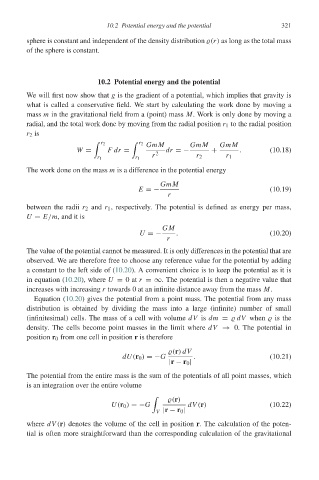
            We will first now show that g is the gradient of a potential, which implies that gravity is
            what is called a conservative field. We start by calculating the work done by moving a
            mass m in the gravitational field from a (point) mass M. Work is only done by moving a
            radial, and the total work done by moving from the radial position r 1 to the radial position
            r 2 is
                                            GmM         GmM     GmM
                                r 2       r 2

                         W =      Fdr =           dr =−       +      .        (10.18)
                                              r 2         r 2     r 1
                               r 1       r 1
            The work done on the mass m is a difference in the potential energy
                                                GmM
                                          E =−                                (10.19)
                                                  r
            between the radii r 2 and r 1 , respectively. The potential is defined as energy per mass,
            U = E/m, and it is
                                                 GM
                                          U =−      .                         (10.20)
                                                  r
            The value of the potential cannot be measured. It is only differences in the potential that are
            observed. We are therefore free to choose any reference value for the potential by adding
            a constant to the left side of (10.20). A convenient choice is to keep the potential as it is
            in equation (10.20), where U = 0at r =∞. The potential is then a negative value that
            increases with increasing r towards 0 at an infinite distance away from the mass M.
              Equation (10.20) gives the potential from a point mass. The potential from any mass
            distribution is obtained by dividing the mass into a large (infinite) number of small
            (infinitesimal) cells. The mass of a cell with volume dV is dm =   dV when   is the
            density. The cells become point masses in the limit where dV → 0. The potential in
            position r 0 from one cell in position r is therefore
                                                   (r) dV
                                      dU(r 0 ) =−G       .                    (10.21)
                                                  |r − r 0 |
            The potential from the entire mass is the sum of the potentials of all point masses, which
            is an integration over the entire volume
                                                   (r)

                                   U(r 0 ) =−G         dV (r)                 (10.22)
                                               V |r − r 0 |
            where dV (r) denotes the volume of the cell in position r. The calculation of the poten-
            tial is often more straightforward than the corresponding calculation of the gravitational

