


Page 350 - Physical Principles of Sedimentary Basin Analysis
P. 350
332                      Gravity and gravity anomalies

                                                                   x


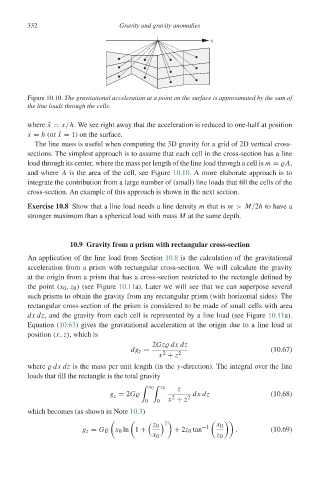
                 Figure 10.10. The gravitational acceleration at a point on the surface is approximated by the sum of
                 the line loads through the cells.

                      x
                 where ˆ = x/h. We see right away that the acceleration is reduced to one-half at position
                         x
                 x = h (or ˆ = 1) on the surface.
                   The line mass is useful when computing the 3D gravity for a grid of 2D vertical cross-
                 sections. The simplest approach is to assume that each cell in the cross-section has a line
                 load through its center, where the mass per length of the line load through a cell is m =  A,
                 and where A is the area of the cell, see Figure 10.10. A more elaborate approach is to
                 integrate the contribution from a large number of (small) line loads that fill the cells of the
                 cross-section. An example of this approach is shown in the next section.

                 Exercise 10.8 Show that a line load needs a line density m that is m > M/2h to have a
                 stronger maximum than a spherical load with mass M at the same depth.


                            10.9 Gravity from a prism with rectangular cross-section
                 An application of the line load from Section 10.8 is the calculation of the gravitational
                 acceleration from a prism with rectangular cross-section. We will calculate the gravity
                 at the origin from a prism that has a cross-section restricted to the rectangle defined by
                 the point (x 0 , z 0 ) (see Figure 10.11a). Later we will see that we can superpose several
                 such prisms to obtain the gravity from any rectangular prism (with horizontal sides). The
                 rectangular cross-section of the prism is considered to be made of small cells with area
                 dx dz, and the gravity from each cell is represented by a line load (see Figure 10.11a).
                 Equation (10.63) gives the gravitational acceleration at the origin due to a line load at
                 position (x, z), which is
                                                   2Gz  dx dz
                                             dg z =                                (10.67)
                                                      2
                                                     x + z 2
                 where   dx dz is the mass per unit length (in the y-direction). The integral over the line
                 loads that fill the rectangle is the total gravity


                                                  x 0  z 0  z
                                       g z = 2G         2   2  dx dz               (10.68)
                                                 0  0  x + z
                 which becomes (as shown in Note 10.3)


    2
                                                   z 0          −1  x 0
                                g z = G  x 0 ln 1 +      + 2z 0 tan      .         (10.69)
                                                   x 0              z 0

